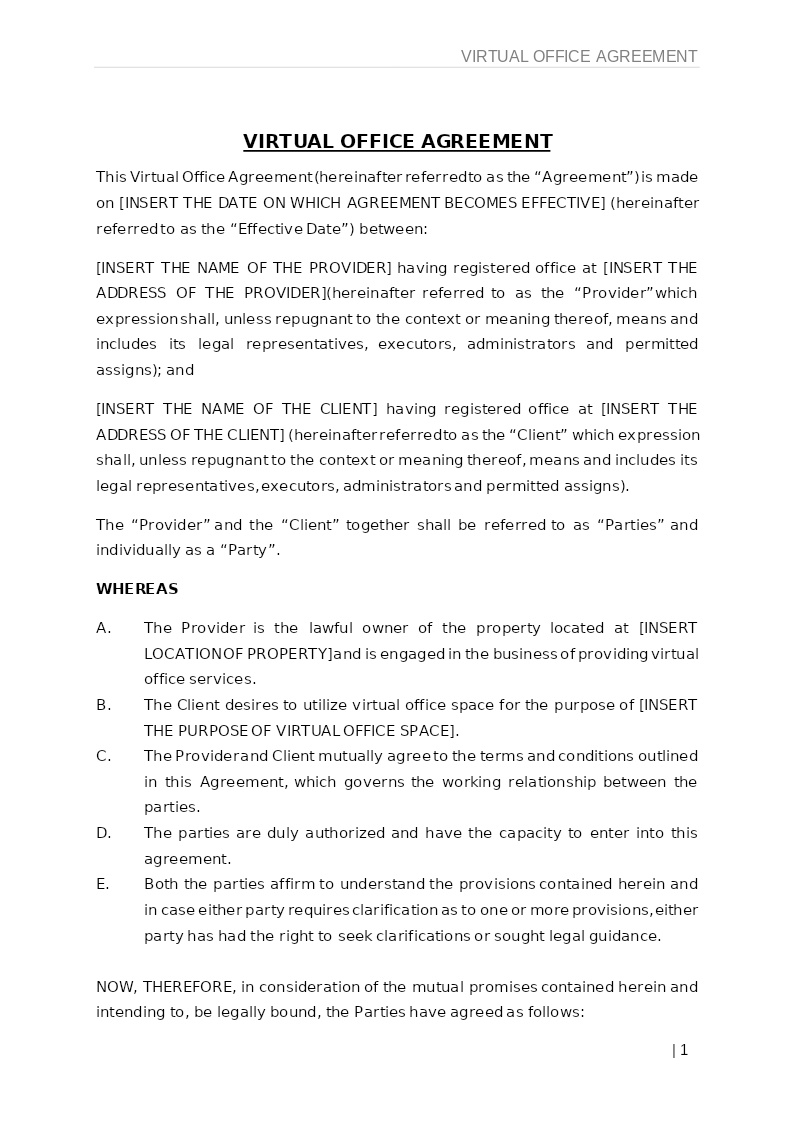
VIRTUAL OFFICE AGREEMENT
How does it work?
1. Choose this template
Start by clicking on "Fill out the template"
2. Complete the document
Answer a few questions and your document is created automatically.
3. Save - Print
Your document is ready! You will receive it in Word and PDF formats. You will be able to modify it.
Understanding Virtual Office Agreements
A Virtual Office Agreement is a legally binding contract that outlines the terms under which a business can use a third-party provider’s address, administrative services, and workspace facilities without physically occupying a full-time office. These agreements define mail handling, business address usage, receptionist services, meeting room access, digital communication tools, and compliance obligations.
In the United States, Virtual Office Agreements are governed by state contract law, postal regulations, anti-fraud compliance requirements, leasing and zoning rules, data privacy laws, and business licensing standards. For many startups, freelancers, remote teams, and service-based businesses, a virtual office provides the flexibility of a professional presence without long-term real estate commitments.
Where Virtual Office Agreements Are Commonly Used
Virtual office services are widely used across a range of industries and business types, including:
- Startups seeking a professional business address for incorporation
- Remote teams needing occasional workspace or conference rooms
- Freelancers and consultants looking to maintain privacy for home addresses
- Small businesses expanding into new U.S. states or markets
- E-commerce brands requiring a commercial mailing address
- International companies establishing a U.S. presence
- Service-based businesses needing call answering or administrative support
Any business that needs a professional presence without a physical office lease can benefit from a Virtual Office Agreement.
Different Types of Virtual Office Services You May Encounter
- Business Address & Mail Handling: Use of a commercial address for mail, legal notices, and marketing materials, including mail forwarding or scanning services.
- Phone Answering & Reception Services: Live or automated call handling to create a professional customer experience.
- Meeting Rooms & Workspace Access: Booking rights for conference rooms, coworking spaces, and private offices as needed.
- Administrative & Support Services: Support such as scheduling, document handling, digital communication tools, and on-demand assistance.
- Compliance & Verification Services: Provider support for business registration, KYC verification, and compliance with postal regulations (such as USPS Form 1583).
When Legal Guidance Becomes Helpful
Legal review may be beneficial when:
- A business needs clarity on mail-handling procedures, privacy protections, or data retention
- Multiple users or remote team members will have access to services
- The business must comply with state licensing, postal, or regulatory obligations
- The address will be used for company formation, tax registration, or receiving legal notices
- Providers offer add-on services such as call forwarding, digital mail platforms, or workspace access
- The agreement includes service limits, renewal terms, liability caps, or termination fees
Legal guidance ensures the agreement remains compliant with U.S. state rules and meets the business’s operational needs.
How to Work with This Template
- Identify the service provider and business using the virtual office
- Choose the services included: address, mail handling, receptionist, workspace, etc.
- Specify service hours, usage limits, forwarding options, and administrative support
- Include data privacy obligations and USPS Form 1583 requirements (if applicable)
- Outline payment schedules, billing cycles, and termination rights
- Choose the governing U.S. state law for enforcement
- Review liability limitations, security policies, and acceptable use rules
- Sign electronically or in hard copy
This template is compatible with major U.S. e-signature platforms and follows industry practices used by virtual office and coworking providers.
Frequently Asked Questions
Q1. What is a Virtual Office Agreement and how does it work?
A Virtual Office Agreement outlines the terms under which a business uses a service provider’s address, mail-handling services, receptionist support, and on-demand workspace. It gives companies a professional presence without the cost of leasing a physical office, making it ideal for remote teams, new businesses, and out-of-state expansions.
Q2. Is a virtual office address legally accepted in the U.S.?
Yes. Most U.S. states allow businesses to use a virtual office address for marketing, client communication, and general business purposes. However, some states have specific rules regarding using a virtual address for licensing or registered agent services. Many providers support compliance with postal regulations such as USPS Form 1583.
Q3. Can I use a virtual office for business registration or LLC formation?
In many cases, yes. A virtual office can be used as a business address for incorporation, tax filings, and official mail. However, it typically cannot replace a registered agent address, which has specific legal requirements under state law. Always confirm the rules in the state where you form your business.
Q4. What services are included in a typical Virtual Office Agreement?
Most agreements include a professional business address, mail handling, mail forwarding, call answering, and access to meeting rooms or coworking spaces. Some providers offer additional services such as digital mail scanning, receptionist support, administrative assistance, and conference room rentals.
Q5. Are virtual office services secure and private?
Yes. Virtual office providers follow strict mail-handling and privacy procedures, and many comply with data protection laws, USPS regulations, and industry confidentiality standards. For businesses that operate remotely, this offers added protection compared to using a personal home address.
Q6. Can I receive legal notices or packages at a virtual office?
Yes. Most virtual office providers accept mail, packages, and legal documents on behalf of clients. The agreement outlines how delivery, forwarding, and notification processes work. Businesses often use virtual offices to ensure that important mail is received securely and promptly.
Q7. Are monthly fees fixed or variable?
Most providers charge a fixed monthly fee based on the service package selected. Additional fees may apply for mail forwarding, meeting room usage, administrative support, or exceeding service limits. The agreement will clearly outline all charges and billing cycles.
Q8. Is a virtual office suitable for small and home-based businesses?
Absolutely. Virtual offices help small businesses maintain a professional image, protect personal privacy, and operate remotely without the cost of a full office lease. They are especially beneficial for freelancers, consultants, startups, and online businesses.
Q9. Can I cancel a Virtual Office Agreement at any time?
Cancellation terms vary by provider. Many agreements allow month-to-month cancellation, while others include minimum commitment periods or notice requirements. The contract will specify any termination fees, advance notice, or procedures for returning keys or access credentials.
Q10. Are electronic signatures valid for Virtual Office Agreements?
Yes. The U.S. ESIGN Act recognizes electronic signatures as legally enforceable. Most virtual office providers use online signing platforms, ensuring fast and secure agreement execution.