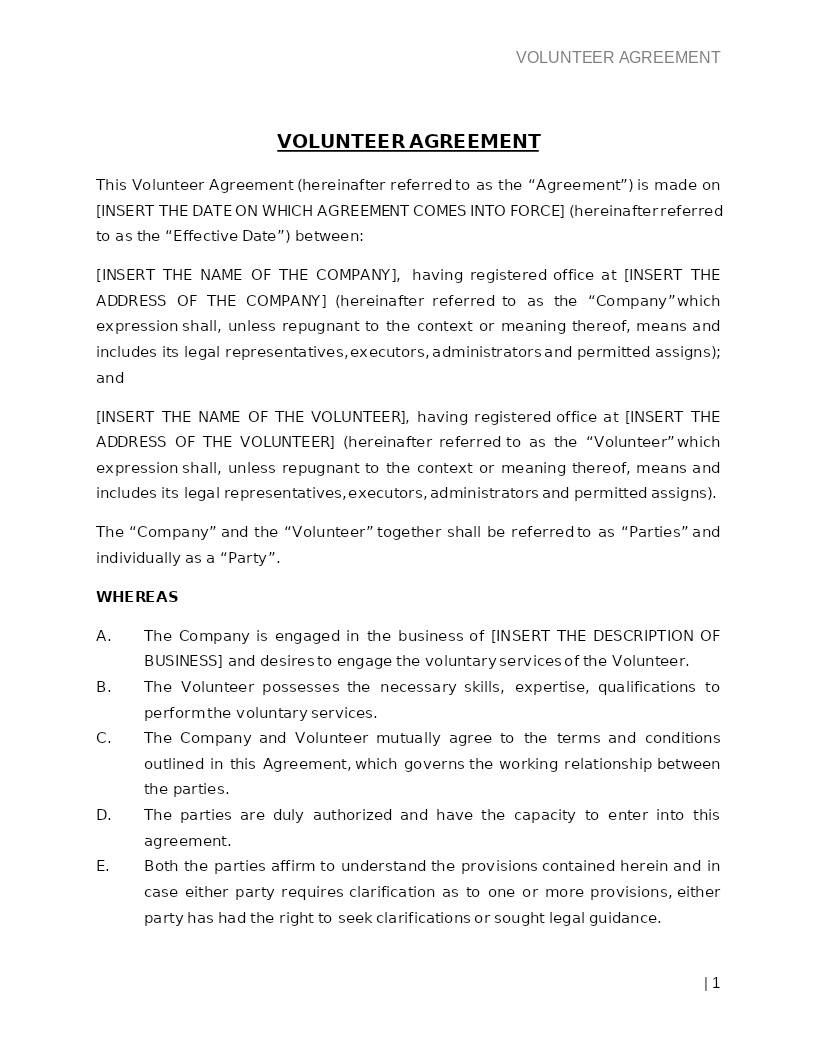
VOLUNTEER AGREEMENT
How does it work?
1. Choose this template
Start by clicking on "Fill out the template"
2. Complete the document
Answer a few questions and your document is created automatically.
3. Save - Print
Your document is ready! You will receive it in Word and PDF formats. You will be able to modify it.
Outlines the roles and responsibilities of the organization and the volunteer
Organizations that rely on voluntary participation, such as nonprofits, charities, community organizations, educational institutions, and event-based programs, must establish a clear legal framework governing the expectations, duties, rights, and obligations of their volunteers, and for that purpose a Volunteer Agreement provides that structure. It outlines the scope of volunteer services, the standards of conduct required, the confidentiality obligations, and the limitations of the relationship, ensuring that both the organization and the volunteer understand their roles.
A Volunteer Agreement helps create a trusted environment in which volunteers may contribute their time, skills, and efforts without confusion regarding responsibilities, liability issues, or the nature of the engagement. It defines what is expected of volunteers, how organizational resources may be used, and what restrictions apply to access, confidentiality, and representation of the organization. For the organization, the agreement prevents misunderstandings and establishes legal safeguards by clarifying that the volunteer role does not constitute employment, does not create entitlement to wages, and does not confer employment benefits.
Volunteer agreements are widely used across community service programs, non-governmental organizations, arts and cultural institutions, schools, religious bodies, disaster-relief groups, and event operations. Whenever individuals participate in activities under the direction or supervision of an organization without monetary compensation, a Volunteer Agreement helps ensure transparency, accountability, and legal compliance.
Where Volunteer Agreements Are Commonly Used
Volunteer agreements are standard across many settings, including:
- Nonprofits engaging volunteers for administrative, outreach, or field activities
- Charitable events requiring volunteers for logistics, registration, or crowd management
- Schools, libraries, and educational institutions enrolling student or parental volunteers
- Hospitals or community clinics using volunteer support for non-medical tasks
- Animal shelters, environmental conservation programs, or community clean-up efforts
- Religious organizations coordinating service, youth, or community programs
- Arts, sports, or public events using volunteer staff for operations and coordination
- Disaster relief, emergency response, or humanitarian aid missions
- Any time an individual performs tasks for an organization without compensation and under its direction, a Volunteer Agreement ensures clarity and protects both parties.
Types of Volunteer Agreements
- General Volunteer Agreement: Covers routine volunteer activities for ongoing programs.
- Event-Specific Volunteer Agreement: Used for short-term or one-time events, festivals, or campaigns.
- Confidentiality and Volunteer NDA Hybrid Agreement: Used when volunteers have access to sensitive or proprietary information.
- Youth or Minor Volunteer Agreement: Requires parental consent and additional safeguards.
- Specialized Volunteer Agreement: Tailored to volunteers handling animals, high-risk tasks, vulnerable populations, or regulated activities.
When Legal Guidance Becomes Helpful
Legal review is valuable when:
- Volunteers access confidential, proprietary, or sensitive information
- The role involves interaction with vulnerable individuals (children, elderly, disabled persons)
- The volunteer will handle hazardous equipment, chemicals, or physical labor.
- Insurance, liability waivers, or indemnification clauses are required
- The organization must ensure compliance with local volunteer protection statutes
- Background checks, training certifications, or safety briefings are mandatory
- Volunteers represent the organization publicly, online, or in outreach campaigns
Proper legal guidance ensures that the agreement protects the organization without exposing volunteers to unnecessary risk.
How to Work With This Template
- Identify the organization and volunteer
- Specify the nature, purpose, and duration of the volunteer services
- Outline duties, rules of conduct, and confidentiality expectations
- Clarify that the relationship is not employment and confers no wages or benefits
- Include safety requirements, training obligations, and risk acknowledgments
- Specify use of organizational property, data, and intellectual assets
- Select governing law and dispute resolution provisions
- Sign electronically or in hard copy
This structure follows widely recognized nonprofit governance and volunteer management best practices.
Frequently Asked Questions (FAQs)
Q1. Is a Volunteer Agreement legally required?
While not mandated by law in most jurisdictions, a volunteer agreement is strongly recommended. It provides legal clarity and prevents disputes regarding expectations, confidentiality, safety, and the volunteer’s non-employee status. It also protects the organization from potential wage claims or misclassification liability.
Q2. Does a volunteer agreement create an employment relationship?
No. A properly drafted Volunteer Agreement expressly states that the volunteer serves without wages, benefits, or employment status. This prevents claims to minimum wage, overtime, workers’ compensation, unemployment benefits, or wrongful termination protections. The Agreement should clearly distinguish the relationship from employment under labor laws.
Q3. Can volunteers receive stipends, reimbursements, or benefits?
Volunteers may receive reimbursements for actual out-of-pocket expenses (travel, supplies, meals). They may also receive small tokens of appreciation, so long as such payments cannot be construed as compensation. Any regular, ongoing, or performance-based payments risk reclassifying the volunteer as an employee under wage laws.
Q4. Are volunteers automatically covered by the organization’s insurance?
Not necessarily. Some organizations carry volunteer accident or liability insurance, but many do not. The Agreement should clarify whether the organization provides insurance, the scope of coverage, the volunteer’s duty to maintain personal health insurance, and exclusions for high-risk activities. This transparency helps manage expectations and liability exposure.
Q5. Must volunteers undergo background checks?
Where volunteers work with children, elderly persons, disabled individuals, or sensitive organizational information, background checks are essential and often legally required. The Agreement may require volunteers to consent to screenings, fingerprinting, or ongoing vetting processes.
Q6. Can volunteers be held liable for damages?
Volunteers may be liable for intentional misconduct, criminal activity, or acts of gross negligence. Many jurisdictions provide limited immunity for volunteers acting in good faith within the scope of their assigned duties. The Agreement may include indemnification clauses, limitation-of-liability provisions, and risk acknowledgments to protect both parties.
Q7. Does the Agreement cover confidentiality?
Yes. Volunteers often access private donor data, beneficiary information, proprietary materials, or operational records. The agreement typically includes confidentiality provisions similar to an NDA, preventing volunteers from using or disclosing such information without authorization.
Q8. Can a volunteer withdraw from the role at any time?
Most volunteer relationships are at-will, allowing the volunteer to discontinue service at any time. However, for events or programs reliant on staffing commitments, the Agreement may request advance notice to ensure operational continuity.
Q9. Can the organization terminate a volunteer?
Yes. An organization may remove a volunteer at any time for misconduct, noncompliance, safety concerns, lack of attendance, policy violations, reputational risk, or operational necessity. The agreement outlines grounds for termination and the procedures for returning organizational property.
Q10. Is parental consent required for minor volunteers?
Yes. Minors can volunteer only with signed parental or guardian consent. The Agreement should also specify supervision requirements, permitted tasks, hours of work, and any restrictions on physical or high-risk activities.
Q11. Are electronic signatures valid?
Yes. Volunteer Agreements may be executed electronically in accordance with e-signature laws such as the ESIGN Act and UETA. Electronic execution is widely used for onboarding large numbers of volunteers efficiently.
Q12. Can volunteers use the organization’s equipment for personal purposes?
No. Equipment, facilities, computers, software, logos, and intellectual property must be used strictly for authorized volunteer activities. Unauthorized use may result in termination and potential legal consequences.
Q13. Who owns intellectual property created by volunteers?
Work products created in the course of volunteer activities, such as graphics, writings, programs, designs, or materials, typically belong to the organization. Many agreements include an IP assignment clause stating that such contributions become the organization’s exclusive property.
Q14. Are volunteers allowed to publicly represent the organization?
Yes, but only with prior approval. The Agreement may require volunteers to follow media and communication policies, refrain from unauthorized public statements, and adhere to branding rules when posting online or interacting with press or beneficiaries.
Q15. What happens if a volunteer is injured?
The Agreement should clarify whether the organization provides accident or liability insurance, the volunteer must rely on personal health coverage, or the volunteer assumes inherent risks associated with their activities. Clear provisions help avoid misunderstandings and minimize liability disputes.