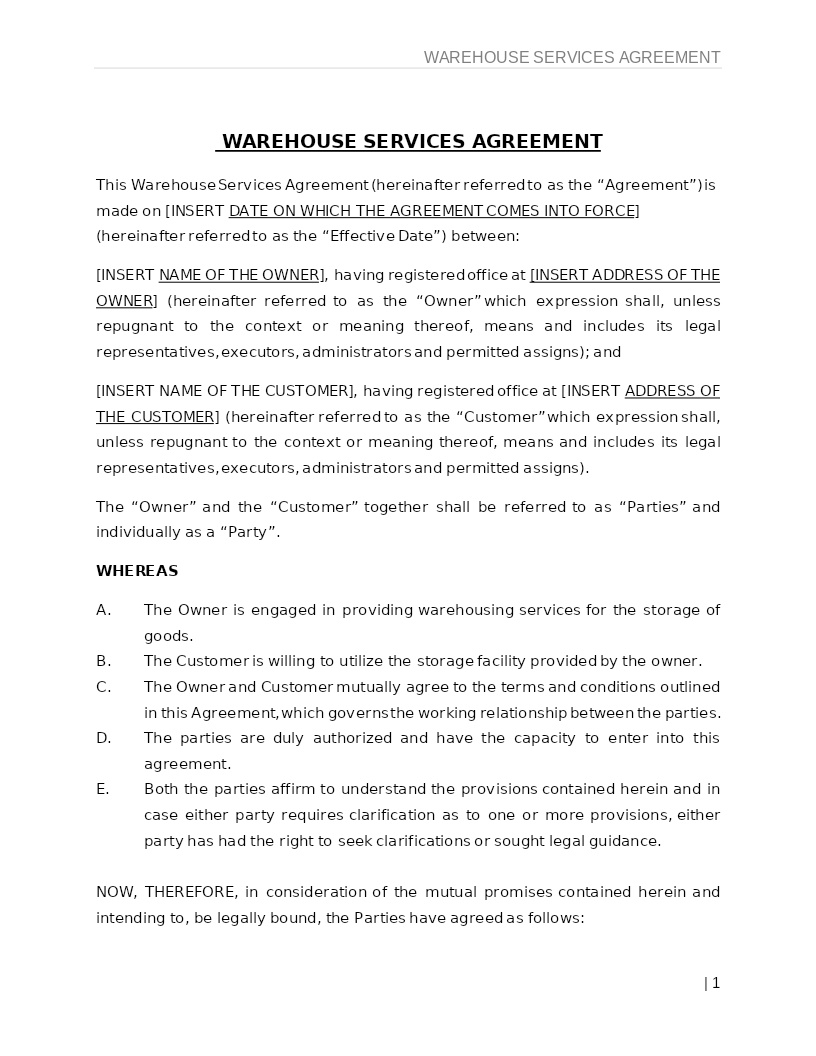
WAREHOUSE SERVICES AGREEMENT
How does it work?
1. Choose this template
Start by clicking on "Fill out the template"
2. Complete the document
Answer a few questions and your document is created automatically.
3. Save - Print
Your document is ready! You will receive it in Word and PDF formats. You will be able to modify it.
Providing Structure and Legal Protection for Warehousing and Storage Services in the United States
Businesses across the United States rely on third-party warehouses for inventory storage, distribution, fulfillment, packaging, and logistics support. A Warehouse Services Agreement provides the legally binding framework governing these services.
This Agreement outlines the rights and obligations of the warehouse operator (“Warehouseman”) and the customer (“Depositor”) concerning the receipt, handling, storage, safeguarding, and release of goods. It establishes key terms relating to storage fees, insurance requirements, liability limits, inventory management, delivery schedules, documentation, warehouse receipts, and compliance with U.S. commercial and logistics laws.
Warehouse Services Agreements also ensure compliance with the Uniform Commercial Code (UCC Article 7), which governs warehouse receipts and the obligations of warehouse operators across the United States. The Agreement further addresses federal and state safety regulations, transportation laws, and industry standards for the handling of goods, hazardous materials, temperature-controlled products, and cross-docking services. By using a Warehouse Services Agreement, both parties benefit from legal clarity, reduced liability exposure, and reliable, transparent warehouse operations.
Where Warehouse Services Agreements Are Commonly Used
Warehouse service contracts are widely used across U.S. industries, including:
- Third-party logistics (3PL) providers
- E-commerce distribution centers and fulfillment warehouses
- Manufacturers storing raw materials or finished goods
- Retail supply chains and wholesale distributors
- Cold storage, refrigerated, and perishable goods facilities
- Freight forwarding and cross-docking operations
- Hazardous materials storage (subject to regulatory restrictions)
- Food, beverage, and pharmaceutical warehousing
- Import/export bonded warehouses
- Amazon FBA prep centres and direct-to-consumer fulfilment hubs
Any business storing goods with a third-party facility in the United States should use a written Warehouse Services Agreement.
Different Types of Warehouse Services Agreements You May Encounter
1. Standard Warehouse Storage Agreement: For general inventory storage and handling.
2. Third-Party Logistics (3PL) Service Agreement: Covers pick-and-pack, order fulfillment, and distribution services.
3. Cold Storage Warehouse Agreement: For refrigerated, frozen, or temperature-controlled goods.
4. Bonded Warehouse Agreement: Used for goods under customs control.
5. Hazardous Materials Warehouse Agreement: With specialized safety and regulatory terms.
6. Cross-Docking or Transloading Agreement: For quick transfer of goods without long-term storage.
When Legal Guidance Becomes Helpful
Legal review is recommended when:
- High-value, fragile, or regulated goods are stored
- The warehouse handles food, medical supplies, pharmaceuticals, or chemicals
- The customer requires extended warehouse liability or insurance coverage
- The warehouse issues negotiable or non-negotiable receipts under UCC Article 7
- The contract includes complex service levels (SLAs) or performance guarantees
- Goods are imported/exported and subject to customs regulations
- Temperature-controlled, hazardous, or bonded storage is required
- The parties need indemnification for loss, theft, or supply chain disruption
A well-drafted agreement minimizes risk and ensures compliance with federal and state requirements.
How to Work With This Template
- Identify the warehouse operator and customer
- Specify goods to be stored, including packaging, condition, and handling instructions
- Define storage fees, service charges, and billing cycles
- Establish receipt, handling, and delivery processes
- Include liability limits consistent with UCC Article 7
- Address insurance coverage and loss/damage procedures
- Set inventory reporting, access rules, and operating hours
- Provide termination rights and removal procedures
- Execute the Agreement electronically (valid under the ESIGN Act) or in writing
This structure aligns with U.S. warehousing industry standards and legal requirements.
Frequently Asked Questions
Q1. What is a Warehouse Services Agreement in the United States?
A Warehouse Services Agreement is a legally binding contract between a warehouse operator and a customer outlining terms for storing, handling, and releasing goods. It defines service obligations, fees, liability, insurance requirements, and compliance with UCC Article 7, which governs warehouse receipts and storage obligations across the U.S.
Q2. Why is a written warehouse contract important?
A written agreement helps:
- prevent disputes over storage fees and service quality,
- clarify liability for lost or damaged goods,
- establish proper documentation (receipts, inventory reports),
- ensure safety and regulatory compliance,
- define responsibilities for packaging, labelling, and handling.
- Protect both parties with clear risk allocation.
Warehousing inherently involves valuable inventory—written terms protect both sides.
Q3. Who is responsible for loss or damage to stored goods?
Under U.S. law the warehouseman is liable only if loss results from their failure to exercise reasonable care, as required by UCC Article 7. The customer is responsible for proper packaging, accurate descriptions, and compliance with shipping laws. Many warehouses limit liability to a fixed dollar amount per unit unless the customer pays for higher coverage.
Q4. Do customers need insurance for stored goods?
Yes. Most U.S. warehouses require customers to carry insurance covering inventory loss or damage, theft or natural disasters, temperature failure (for perishable goods), shortages, or transit-related losses. Warehouse operators typically carry their own liability insurance, but it does not replace the customer’s inventory insurance.
Q5. What documents are issued under a Warehouse Services Agreement?
Common documents issued under this agreement include Warehouse Receipts (negotiable or non-negotiable under UCC Article 7), Bills of Lading (if transport is provided), Inventory Reports, Delivery Orders, and Condition Reports. These documents establish legal proof of storage, ownership, and handling.
Q6. Can the warehouse refuse unsafe or improperly packaged goods?
Yes. U.S. warehouses may refuse goods that are hazardous or undeclared, have improper packaging, violate safety or environmental regulations, or require special storage conditions not available at the facility. This protects the facility, employees, and other stored inventory.
Q7. Are warehousemen allowed to move goods inside the facility?
Yes. Warehouses generally reserve the right to reposition or relocate goods internally for operational or safety purposes. However, handling fees may apply depending on the movement required.
Q8. Can customers access the warehouse to inspect their goods?
Typically yes, but subject to advance notice, security requirements, warehouse operating hours, and safety rules (PPE, escort policies). Inspection terms should be defined in the agreement.
Q9. What happens if the customer fails to pay storage fees?
Under UCC Article 7, the warehouse has a warehouseman’s lien, allowing them to hold goods until payment is made, charge late fees, and ultimately sell the goods through a lawful lien sale if the customer defaults. Lien rights must be exercised strictly according to state law.
Q10. Are electronic signatures valid for Warehouse Services Agreements?
Yes. Under the ESIGN Act and UETA, electronic signatures and records are legally valid throughout the United States.
Q11. Can the Agreement include order fulfillment, pick-and-pack, or shipping tasks?
Yes. Many warehouses operate as 3PLs, offering order processing, labeling and packaging, carrier coordination, and shipping and tracking services. The Agreement should clearly define each service and applicable fee.