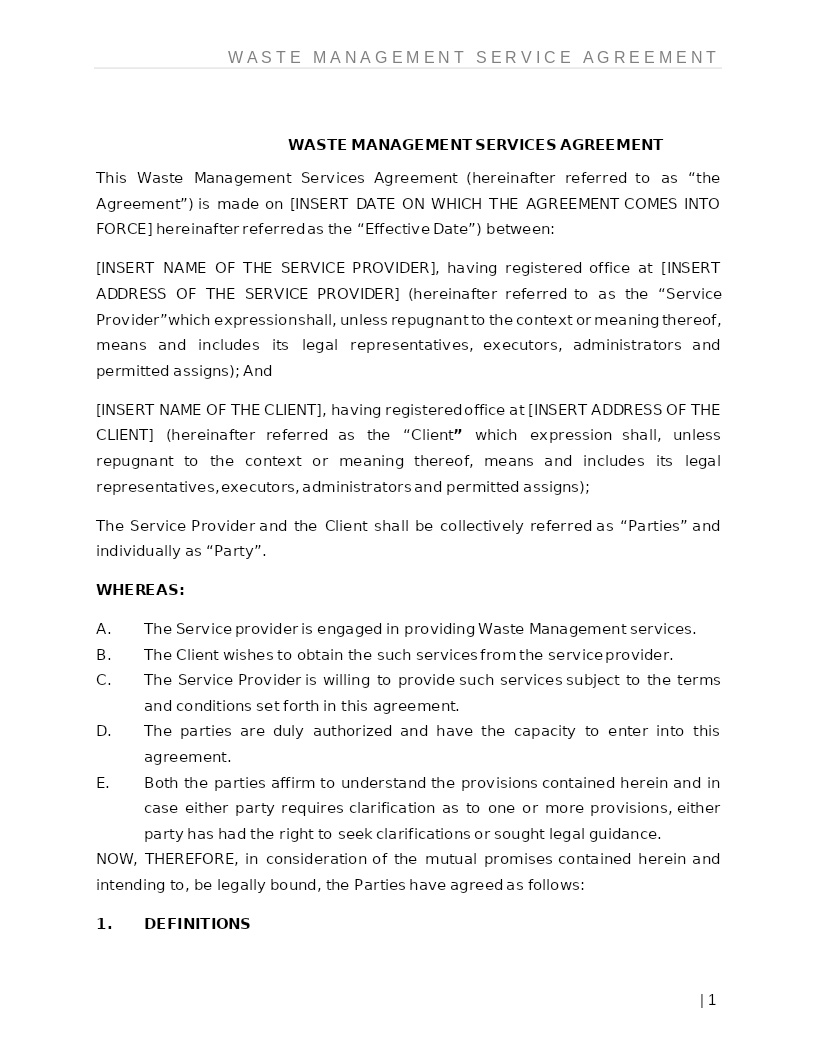
WASTE MANAGEMENT SERVICES AGREEMENT
How does it work?
1. Choose this template
Start by clicking on "Fill out the template"
2. Complete the document
Answer a few questions and your document is created automatically.
3. Save - Print
Your document is ready! You will receive it in Word and PDF formats. You will be able to modify it.
Establishing Environmental and Disposal Obligations Through a Waste Management Service Agreement
Businesses, construction firms, residential associations, and commercial facilities frequently require professional waste collection, recycling, and disposal services to comply with environmental regulations and maintain operational hygiene. To ensure a clear understanding of responsibilities and to protect both parties from regulatory or liability exposure, the engagement is formalized through a Waste Management Service Agreement. This agreement outlines the terms under which a waste-management provider collects, transports, processes, and disposes of various types of solid waste, recyclable materials, organic waste, hazardous substances, or industrial byproducts in accordance with U.S. federal, state, and local laws, including EPA guidelines, OSHA requirements, DOT transportation rules, and relevant environmental-protection statutes.
A Waste Management Service Agreement ensures that waste-collection schedules, container requirements, disposal methods, environmental-compliance obligations, indemnification duties, service fees, and liability protections are explicitly defined. The agreement protects the client by ensuring proper waste handling and protects the provider by clarifying access rights, volume limits, contamination restrictions, and service-related limitations. It ultimately establishes a legally enforceable framework that promotes sustainability, compliance, and accountability throughout the waste-collection and disposal process.
Where Waste Management Service Agreements Are Commonly Used
Waste Management Service Agreements are widely utilized across numerous sectors, including:
- Commercial buildings requiring regular waste pickup and recycling services
- Construction companies generating debris, scrap, and hazardous materials
- Restaurants, hotels, and hospitality businesses with food-waste and organic-waste needs
- Manufacturing facilities producing industrial waste or regulated materials
- Municipal organizations and community associations handling residential waste
- Retail centers, malls, and shopping complexes requiring consistent waste removal
- Healthcare offices or labs producing biohazard or special-handling waste
- Offices seeking cost-effective and compliant waste-disposal programs
Wherever waste is generated, and disposal must meet regulatory standards, a Waste Management Service Agreement is essential.
Different Types of Waste Management Service Agreements
1. Solid Waste Collection Agreements: Cover standard trash removal, bin placement, and scheduled pickups.
2. Recycling and Sustainability Agreements: Focus on paper, cardboard, plastics, glass, and other recyclable materials.
3. Hazardous Waste Disposal Agreements: Address regulated chemicals, industrial byproducts, or biohazards requiring specialized handling.
4. Construction and Roll-Off Container Agreements: Provide temporary dumpsters, debris removal, and project-based disposal.
5. Organic Waste and Composting Agreements: Manage food waste and landscaping byproducts and compostable materials.
6. Full-Service Waste Management Contracts: Combine multiple waste streams and include compliance reporting, audits, and ongoing monitoring.
When Legal Guidance Becomes Helpful
Legal counsel may be required when:
- The agreement covers hazardous waste governed by strict federal and state regulations
- The client handles chemicals, medical waste, or materials subject to special disposal rules
- Local municipalities impose detailed waste-handling ordinances
- Contracted services involve cross-state waste transport regulated by the U.S. Department of Transportation
- The provider requires broad indemnification or limitations of liability
- Disputes arise regarding contamination fees, overweight containers, or improper sorting
- Environmental permits or certifications are required for the disposal process
- The agreement impacts insurance requirements or risk-management planning
Legal review ensures compliance with EPA standards, OSHA regulations, state waste codes, and contractual best practices.
How to Work with This Template
- Identify the service provider, client, and property locations covered by the agreement
- Define waste types, pickup frequency, container specifications, and disposal methods
- Specify contamination rules, prohibited materials, and hazardous-waste protocols
- Outline payment schedules, volume-based pricing, fuel surcharges, or administrative fees
- Detail access requirements, equipment placement, and property-damage responsibilities
- Include environmental-compliance obligations and reporting requirements
- Address insurance coverage, indemnification, and limitations of liability
- Clarify termination procedures, renewal terms, and dispute-resolution mechanisms
- Execute the agreement electronically or in writing in accordance with U.S. e-signature laws
This template reflects industry-standard U.S. waste-management practices and may be used by municipalities, businesses, facilities, and service vendors seeking clear and compliant operational terms.
Frequently Asked Questions
Q1. What is a Waste Management Service Agreement, and why is it important?
A Waste Management Service Agreement is a legally binding contract that outlines how waste is collected, transported, and disposed of by a service provider. It is important because it ensures compliance with environmental regulations, defines each party’s responsibilities, and prevents costly regulatory violations or service disputes.
Q2. Does the agreement cover hazardous waste?
Only if specified. Hazardous waste disposal is heavily regulated under EPA and state laws, and contracts must include specialized handling procedures, certification requirements, and documentation standards.
Q3. Who is responsible for contaminated or prohibited waste?
Typically, the client is responsible for ensuring proper segregation. The agreement should specify contamination fees, rejection procedures, and any additional charges for improper disposal.
Q4. Are electronic signatures enforceable for these agreements?
Yes. Under the ESIGN Act and UETA, electronically signed waste-management agreements are valid and enforceable throughout the United States.
Q5. What happens if the provider cannot access the waste containers?
Access provisions should be outlined in the agreement. Missed pickups due to blocked access may incur additional fees or require rescheduling according to the provider’s policies.
Q6. Can waste-management fees change over time?
Yes. Many agreements include provisions for price adjustments due to fuel costs, disposal-site increases, regulatory changes, or volume fluctuations.
Q7. Does the agreement include environmental-compliance requirements?
Yes. Most agreements require both parties to comply with EPA rules, OSHA safety guidelines, and local waste-handling laws to avoid legal liability.
Q8. Can the service provider subcontract waste-collection services?
Only if the agreement permits it. Subcontractors must typically meet the same compliance and insurance requirements.
Q9. What types of materials are prohibited in standard waste containers?
Hazardous chemicals, batteries, medical waste, flammable materials, and certain electronics are generally prohibited unless a specialized disposal service is included.
Q10. How long do Waste Management Service Agreements usually last?
Terms vary, but many contracts run for one to three years with automatic renewal options. The agreement should specify termination notice requirements.