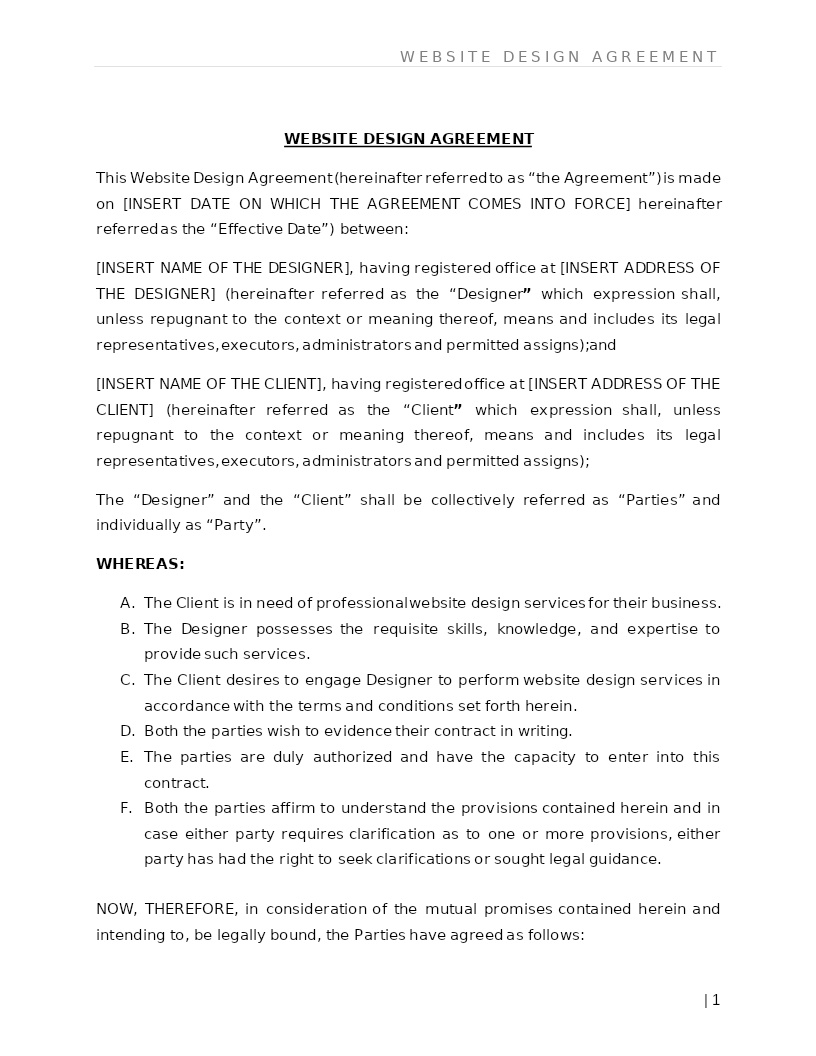
WEBSITE DESIGN AGREEMENT
How does it work?
1. Choose this template
Start by clicking on "Fill out the template"
2. Complete the document
Answer a few questions and your document is created automatically.
3. Save - Print
Your document is ready! You will receive it in Word and PDF formats. You will be able to modify it.
Understanding Website Design Agreements
A Website Design Agreement sets out the terms under which a designer, agency, or developer will create, customize, or redesign a website for a client. It defines the project scope, design requirements, timelines, revisions, intellectual property rights, payment terms, launch responsibilities, and ongoing support arrangements.
For U.S. businesses, this agreement provides a clear framework to manage expectations and avoid disputes, especially when work includes custom graphics, code development, UX/UI design, third-party integrations, or e-commerce features. It ensures both parties understand what will be delivered, in what format, and under what conditions.
Putting this agreement in place creates transparency that allows the designer and client to collaborate confidently, communicate expectations, and protect the ownership rights of both the creative work and business content.
Where Website Design Agreements Are Commonly Used
Website Design Agreements are standard in situations such as:
• Designing a new business website or brand launch
• Redesigning or modernizing an outdated website
• Creating e-commerce stores, landing pages, or membership sites
• Developing custom UX/UI solutions or prototypes
• Building websites for agencies, freelancers, or remote teams
• Integrating CRM tools, analytics, APIs, and third-party systems
• Marketing, branding, and content-driven website projects
Different Types of Website Design Agreements You May Encounter
- Fixed-Scope Design Agreement: Used when deliverables are clearly defined upfront.
- Hourly or Retainer-Based Agreement: Used for open-ended design work, support, or ongoing improvements.
- Full-Service Website Development Agreement: Covers design, coding, hosting setup, content creation, testing, and launch.
- Template Customization Agreement: Used when modifying pre-built templates or site builders like Shopify, WordPress, or Wix.
- E-Commerce Development Agreement: Focuses on online stores, checkout systems, and digital product features.
When Legal Guidance Becomes Helpful
Legal review is helpful when:
• The project includes substantial custom code or complex integrations
• There are shared intellectual property rights or licensing issues
• The design involves personal data, requiring privacy compliance
• The website supports transactions or stores sensitive information
• The client requires ownership of all design files and source code
• There are detailed warranty, maintenance, or hosting obligations
• The business operates across multiple jurisdictions
How to Work with This Template
• Identify the client and designer clearly
• Define the project scope and all design deliverables
• Set timelines, milestones, and the approval process
• Establish payment terms and revision limits
• Clarify who owns copyrights, source files, and final design
• Outline responsibilities for hosting, updates, and testing
• Choose a governing U.S. state law
• Review terms together and sign electronically
Frequently Asked Questions
Q1. What is a Website Design Agreement and why is it important?
A Website Design Agreement outlines how a designer will create or modify a website, detailing timelines, deliverables, payments, and ownership. It is important because it protects both parties, eliminates ambiguity, and ensures the client receives what they are paying for while the designer’s creative work is properly defined and protected.
Q2. Does the client own the website once it is completed?
Ownership depends on the agreement. Many U.S. Website Design Agreements transfer ownership of the final website to the client, but designers may retain rights to underlying tools, templates, or source files. Clear IP clauses prevent confusion regarding what the client can legally modify or reuse.
Q3. How many revisions are included in a typical design project?
Most agreements include a fixed number of revisions rounds to keep the project structured and avoid endless edits. Additional revisions can be billed separately. Setting revision limits helps manage time, cost, and expectations.
Q4. What happens if the project scope changes mid-way?
Scope changes—such as new pages, added features, or custom functionality—typically require a written change order and may affect timelines and pricing. This protects both parties and maintains workflow clarity.
Q5. Are website launch and testing included in the agreement?
Often yes, but it depends on the design package. Some designers provide full testing, compatibility checks, and launch support, while others only provide design files. The agreement specifies exactly what is included.
Q6. Who owns the source code or design files?
This varies. Some designers keep ownership of raw design files (like PSD/AI files) unless the agreement states otherwise. Businesses that want full control should ensure the contract includes source file ownership or licensing rights.
Q7. Can the designer showcase the client’s website in their portfolio?
Most agreements allow designers to use the completed project for portfolios or marketing unless the client requests confidentiality. This should be explicitly stated to avoid misunderstandings.
Q8. Are electronic signatures valid for this agreement?
Yes. Under the U.S. ESIGN Act, electronic signatures are legally enforceable, making it easy for both parties to sign through digital platforms like Docu Sign or Adobe Sign.
Q9. Does the agreement cover ongoing website maintenance?
Not always. Maintenance, updates, or hosting support must be included separately unless specified in the agreement. Many clients opt for a follow-up maintenance contract after launch.
Q10. What if either party fails to meet their obligations?
The agreement typically includes dispute resolution procedures, cure periods, and termination rights. These ensure that missed deadlines, nonpayment, or incomplete work can be addressed fairly and legally.