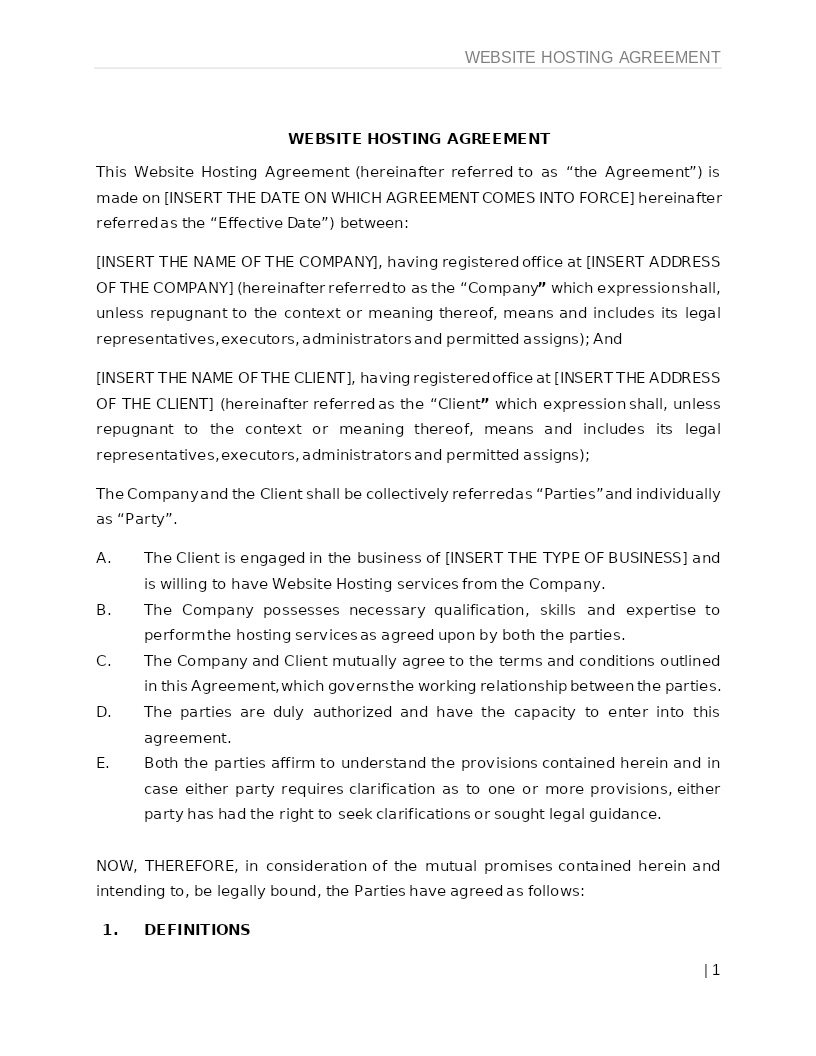
WEBSITE HOSTING AGREEMENT
How does it work?
1. Choose this template
Start by clicking on "Fill out the template"
2. Complete the document
Answer a few questions and your document is created automatically.
3. Save - Print
Your document is ready! You will receive it in Word and PDF formats. You will be able to modify it.
Understanding Website Hosting Agreements
When a business launches a website or digital platform, it relies on a hosting provider to store data, run servers, manage uptime, and ensure public access. A Website Hosting Agreement establishes the framework for this relationship. It defines service levels, data handling standards, uptime guarantees, usage limitations, security obligations, and the responsibilities of both the provider and the client.
Putting a hosting agreement in place creates clarity around performance expectations, support boundaries, intellectual property rights, and what happens if the service is interrupted or misused. This ensures that businesses can confidently operate online without worrying about unexpected downtime, data loss, or policy violations.
Where Website Hosting Agreements Are Commonly Used
Hosting agreements are widely used across U.S. business environments, including:
- Companies launching corporate websites or e-commerce stores
- SaaS platforms hosting customer data and applications
- Marketing agencies managing client web infrastructure
- Startups developing cloud-based tools or online communities
- Professionals hosting blogs, portfolios, or membership sites
- Organizations using dedicated, shared, or cloud-based hosting providers
Any time a website, app, or digital product depends on a third-party server environment, a Website Hosting Agreement defines how the service will be delivered and supported.
Different Types of Websites Hosting You May Encounter
- Shared Hosting: Multiple websites operate on the same server, ideal for small businesses and basic sites.
- VPS (Virtual Private Server) Hosting: A dedicated virtual environment offering more control and performance.
- Dedicated Hosting: The client uses an entire physical server with full administrative control and resources.
- Cloud Hosting: Flexible hosting using distributed cloud architecture with scalable capacity.
- Managed Hosting: Hosting provider also manages updates, security, backups, and performance.
- Colocation Services: Client-owned equipment is placed inside a provider’s data center.
When Legal Guidance Becomes Helpful
While routine hosting plans are straightforward, professional guidance is helpful when:
- Sensitive or regulated data (health, financial, student data, etc.) is being stored
- The agreement includes detailed SLA guarantees, remedies, or performance penalties
- The provider has access to customer data, personal information, or proprietary code
- The website supports high-traffic e-commerce or mission-critical operations
- Backup, disaster recovery, and data retention schedules need customization
- Intellectual property, custom development, or licensing issues arise
- Multiple jurisdictions or cross-border data transfers are involved
Legal review ensures compliance with U.S. privacy laws (CPA, CCPA), industry security standards, and the business’s operational requirements.
How to Work with This Template
- Identify the hosting provider and the client
- Describe the hosting services, including bandwidth, server type, and storage
- Spell out uptime commitments and performance requirements
- Outline security measures, data protections, and backup procedures
- Choose the governing U.S. state law
- Define payment terms, renewal cycles, and termination conditions
- Review SLA terms and support protocols
- Sign electronically or in hard copy
Frequently Asked Questions
Q1. Is a Website Hosting Agreement necessary for small businesses?
Yes. Even small websites rely on uptime, data protection, and reliable hosting. A hosting agreement clarifies what support is included and protects the business if issues arise.
Q2. Does this agreement cover security and data protection?
Yes. Hosting agreements typically include security obligations, backup policies, encryption standards, and breach notification rules, ensuring compliance with U.S. privacy laws.
Q3. What happens if the server goes down?
The agreement outlines uptime guarantees, service credits, and remedies. Higher-tier plans provide stronger SLAs and faster response times.
Q4. Can this agreement be reused for different hosting providers?
Yes, but updating the service scope and SLA terms for each provider ensures accuracy and enforceability.
Q5. Are electronic signatures enforceable?
Yes. Under U.S. ESIGN laws, electronic signatures are valid as long as both parties consent to electronic signing.
Q6. Who owns the website content?
The client typically owns all uploaded content, while the provider owns the server infrastructure. The agreement clarifies IP rights to prevent misuse.
Q7. Does this agreement include domain registration?
Not always. Some hosting providers offer domain services separately. The agreement should specify what is included.
Q8. What if the hosting provider violates the agreement?
The client may request corrections, receive service credits, or terminate the contract depending on the severity of the breach and the terms of the SLA.