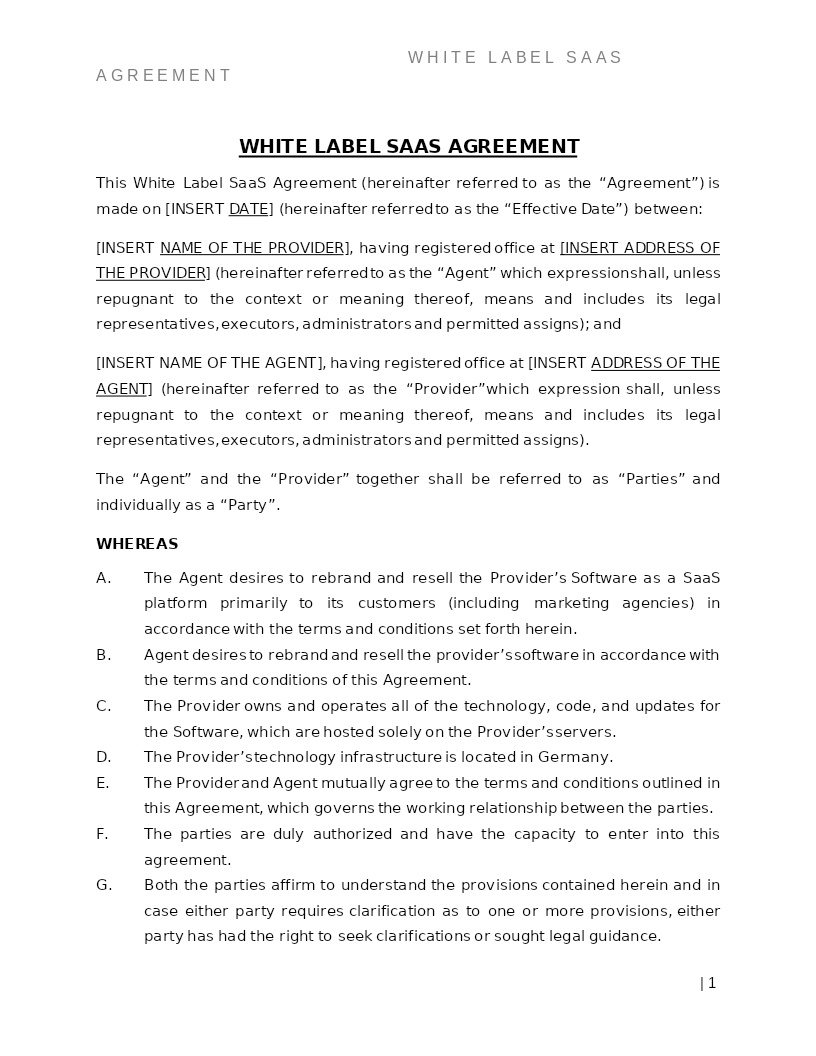
WHITE LABEL SAAS AGREEMENT
How does it work?
1. Choose this template
Start by clicking on "Fill out the template"
2. Complete the document
Answer a few questions and your document is created automatically.
3. Save - Print
Your document is ready! You will receive it in Word and PDF formats. You will be able to modify it.
Delegating Software Delivery Through Rebranded SaaS Licensing Arrangements
As organizations increasingly rely on cloud-based software solutions, many choose to offer third-party technology under their own branding. To properly govern these arrangements, it is essential to establish a contract that defines each party’s rights and obligations. A White Label SaaS Agreement provides such a framework. It outlines the terms under which a Provider grants the Reseller the right to market, rebrand, distribute, or sublicense access to hosted software, subject to U.S. contract law, intellectual property rules, data-privacy regulations, and applicable SaaS industry standards.
By executing a White Label SaaS Agreement, the parties create a legally enforceable structure that regulates branding permissions, licensing rights, data protection duties, integration requirements, payment terms, service levels, and restrictions on modification or competitive use. This ensures that the Reseller can offer the SaaS platform under its own trade name while the Provider maintains ownership and operational control over the underlying technology.
Where White Label SaaS Agreements Are Commonly Used
White label SaaS arrangements are widely used across diverse industries and digital service sectors, including:
- CRM, ERP, HR, and productivity software platforms
- Marketing automation, analytics, and ad-tech solutions
- E-commerce, POS, and inventory management systems
- Project management, collaboration, and workflow tools
- Financial-tech, insure-tech, and health-tech services
- Learning management systems (LMS) and online training platforms
- Customer support, ticketing, and helpdesk solutions
- AI-powered tools, automation systems, and cloud-based applications
Whenever a business wants to sell or distribute a software product under its own branding, a White Label SaaS Agreement governs the legal relationship.
Different Types of White Label SaaS Agreements You May Encounter
1. Full White Label Agreements: Permit complete rebranding of the software, interface, and associated marketing materials.
2. Partial White Label Agreements: Allow limited rebranding, typically including logos, domain masking, and color schemes.
3. Reseller or Agency Agreements: Enable third-party entities to market and sell branded software solutions.
4. OEM SaaS Licensing Agreements: Permit the white-labeled software to be integrated into or bundled with the Reseller’s existing offerings.
5. Multi-Tenant SaaS Agreements: Provide access for the Reseller to serve multiple end-users under its brand.
When Legal Guidance Becomes Helpful
Legal review may be advisable when:
- The SaaS platform processes sensitive, regulated, or confidential data
- Intellectual property rights need to be clearly divided between Provider and Reseller
- The agreement includes usage-based pricing, complex revenue-sharing, or tiered fees
- The Reseller requires broad branding or customization rights
- The service extends across multiple jurisdictions or involves cross-border data transfers
- The Provider uses third-party components, APIs, or licensed content
- Dispute resolution or termination rights may materially impact business continuity
Professional counsel ensures compliance with U.S. contract law, privacy rules, and industry-standard SaaS requirements.
How to Work With This Template
- Identify the SaaS Provider and the Reseller
- Define the branded and unbranded components of the software
- Specify licensing rights, usage restrictions, and customization permissions
- Include service levels, uptime guarantees, and support expectations
- Outline data processing, storage, and confidentiality requirements
- Detail payment terms, fees, and billing schedules
- State ownership of intellectual property, branding assets, and deliverables
- Select governing law and jurisdiction
- Review the agreement for regulatory compliance and clarity
- Execute the agreement electronically or in written form
This template aligns with commonly accepted U.S. SaaS contracting practices and is compatible with major e-signature platforms.
Frequently Asked Questions
1. What is a White Label SaaS Agreement, and why is it important?
A White Label SaaS Agreement is a legally binding contract that allows a Reseller to market and distribute software under its own brand while the Provider retains ownership of the underlying system. It is important because it clarifies licensing rights, branding permissions, data responsibilities, and financial arrangements.
2. Does the Reseller own the software under a white label arrangement?
No. The Provider maintains full ownership of the software, code, and underlying intellectual property. The Reseller is granted limited rights to rebrand and distribute the platform, as permitted under the agreement.
3. Can the Reseller modify the software?
Only if explicitly authorized. Most agreements restrict modification, reverse engineering, or creation of derivative works to protect the Provider’s IP.
4. How are fees typically structured?
Fees may include monthly or annual licensing charges, usage-based fees, per-user pricing, setup fees, or revenue-sharing models. The agreement should specify the exact payment structure.
5. Who is responsible for data privacy and security?
Both parties have defined roles. The Provider typically manages technical security, hosting, and system integrity, while the Reseller must comply with user-facing disclosure, marketing, and data-collection obligations under U.S. privacy laws.
6. Are service levels included in a White Label SaaS Agreement?
Yes. Many agreements incorporate a Service Level Agreement (SLA) outlining uptime, performance, maintenance schedules, response times, and escalation procedures.
7. Can the Reseller use its own branding and domain?
Yes, if the agreement permits domain masking, custom branding, or interface customization. These rights must be expressly defined to avoid misunderstanding.
8. Are electronic signatures valid for White Label SaaS Agreements?
Yes. Under the ESIGN Act, electronic signatures are enforceable, and most SaaS providers rely heavily on digital contract execution.
9. What happens if the Provider discontinues the service?
The agreement should address service discontinuation, data export rights, transition assistance, and any refund or termination terms applicable in such situations.
10. Can the Reseller sublicense the software to end-users?
Many white label models allow sublicensing, but only if expressly granted. The agreement should clearly state the Reseller’s authority to license access to end-customers.
11. Does the agreement cover marketing materials and promotional rights?
Yes. It typically governs the use of logos, trademarks, templates, and documentation, specifying ownership and permitted uses for rebranded assets.