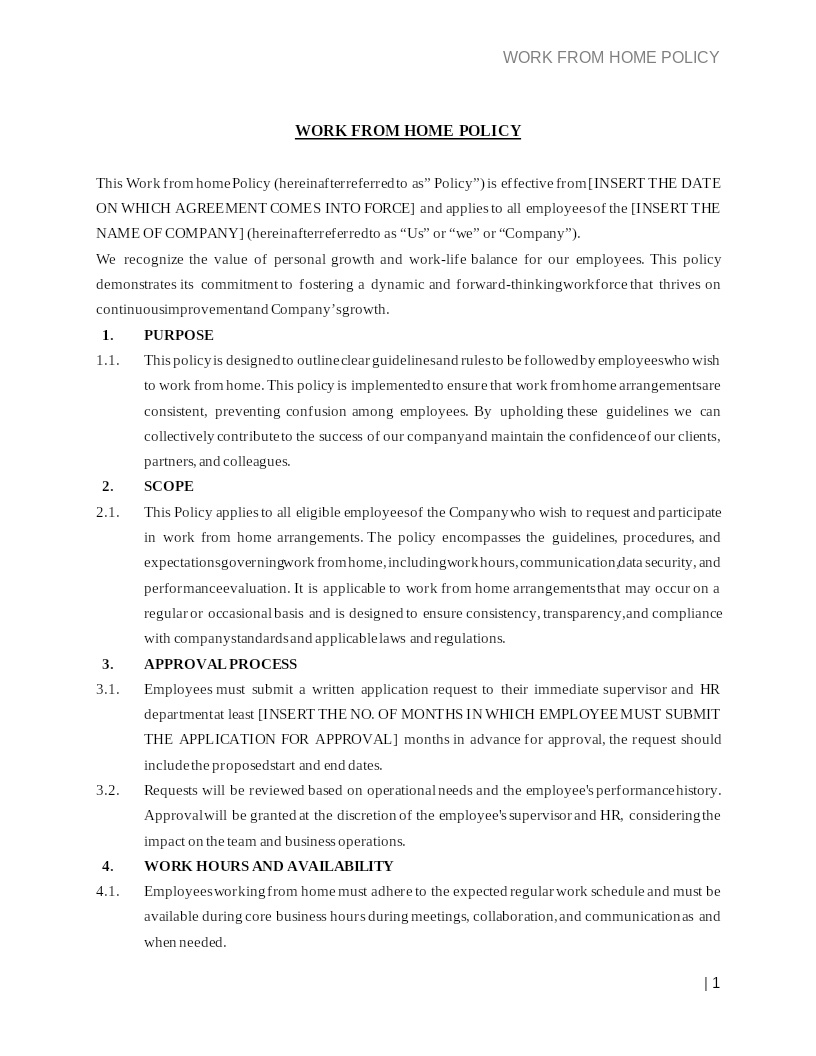
WORK FROM HOME POLICY
How does it work?
1. Choose this template
Start by clicking on "Fill out the template"
2. Complete the document
Answer a few questions and your document is created automatically.
3. Save - Print
Your document is ready! You will receive it in Word and PDF formats. You will be able to modify it.
Supporting Flexible Work Arrangements and Legal Compliance Through a Work from Home Policy
A Work from Home Policy is a formal organizational directive that outlines the standards, expectations, and legal requirements governing remote work arrangements for employees. Developed in accordance with U.S. federal labor laws, including the Fair Labor Standards Act (FLSA), Americans with Disabilities Act (ADA), Occupational Safety and Health Act (OSHA) principles, state wage-and-hour rules, and applicable data-security and privacy obligations, this policy establishes a structured framework for managing employees who perform some or all their duties from home. It ensures that remote work is conducted safely, productively, and in full compliance with legal and organizational requirements, while maintaining accountability and operational continuity.
A comprehensive Work from Home Policy defines eligibility criteria, outlines work-hour expectations, explains timekeeping obligations, and details performance standards applicable to remote employees. It also clarifies requirements surrounding equipment usage, cybersecurity protocols, communication expectations, expense reimbursement, confidentiality safeguards, and work-environment responsibilities. By implementing this policy, organizations create a consistent structure that protects business interests, promotes employee well-being, reduces risk exposure, and ensures compliance with federal and state workplace regulations. The policy serves as a cornerstone for modern workforce management, allowing businesses to balance flexibility with operational control.
Where Work from Home Policies Are Commonly Used
Work From Home Policies support remote work arrangements across a wide range of industries and operational environments, including:
- Corporate offices with hybrid or fully remote workforces
- Technology companies offering flexible work models based on digital infrastructure
- Professional services firms requiring remote client support or virtual collaboration
- Healthcare and insurance organizations performing administrative, billing, or telehealth tasks
- Educational institutions providing online instruction or student-support services
- Financial institutions with compliance-controlled remote processing operations
- Startups and fast-growth companies utilizing remote teams nationwide
- Customer service, sales, and support operations structured around telework systems
Wherever remote work is performed, a Work from Home Policy ensures clarity, structure, and legal compliance.
Different Types of Work from Home Policies You May Encounter
1. General Remote Work Policies: Cover standard remote-work expectations, schedules, communication rules, and eligibility.
2. Hybrid Work Policies: Define split arrangements between office-based and remote workdays.
3. Fully Remote Workforce Policies: Address long-term or permanent telework arrangements across multiple states.
4. Temporary or Emergency Remote Work Policies: Apply to situations such as natural disasters, public health emergencies, or short-term accommodations.
5. Data Security and Technology-Focused Remote Policies: Emphasize cybersecurity, device management, and protection of sensitive information.
When Legal Guidance Becomes Helpful
Legal counsel may be required when:
- Employees work across multiple states with differing wage-and-hour, break, or overtime laws
- Remote-work accommodations intersect with ADA or disability-related requests
- The organization handles protected health information or sensitive data
- Expense reimbursement obligations vary under state law
- Policies intersect with collective-bargaining agreements or union regulations
- Workers’ compensation coverage must be clarified for home-based work environments
- Remote employees access export-controlled, confidential, or proprietary information
- Classification distinctions between employees and independent contractors must be maintained
Legal review ensures the policy aligns with U.S. employment, privacy, safety, and cybersecurity laws, limiting liability and promoting consistent compliance.
How to Work with This Template
- Define eligibility criteria for remote work and outline the application/approval process
- Establish work-hour rules, schedule requirements, overtime restrictions, and timekeeping procedures
- Clarify expectations regarding communication, availability, responsiveness, and virtual-meeting etiquette
- Identify office-equipment standards, technology requirements, and device-security rules
- Provide guidance for creating a safe, ergonomic, and hazard-free remote work environment
- Outline reimbursement rules for home-office equipment or expenses where legally required
- Describe cybersecurity and confidentiality measures to protect company data
- Include performance evaluation standards tailored to remote environments
- Define reporting obligations for workplace injuries occurring at home
- Require acknowledgment through written or electronic signature to ensure compliance
This template reflects widely recognized U.S. remote-work and employment-compliance practices.
Frequently Asked Questions
Q1. What is a Work From Home Policy, and why is it important?
A Work from Home Policy outlines the rules, expectations, and legal requirements for employees who perform their duties remotely. It is important because it establishes consistency, reduces legal risk, and supports productivity and accountability.
Q2. Are employers legally required to have a Work from Home Policy?
While not always mandatory, many employers implement written policies to comply with wage-and-hour rules, data-security obligations, OSHA-related safety expectations, and multi-state risk considerations.
Q3. Do remote employees have the same rights as on-site employees?
Yes. Remote workers remain covered by FLSA wage rules, anti-discrimination laws, harassment protections, and other federal and state employment regulations.
Q4. Does the employer need to reimburse remote-work expenses?
Some states such as California and Illinois require reimbursement of necessary job-related expenses. Other states may require reimbursement depending on circumstances.
Q5. How is time tracked for remote employees?
Employees must accurately record work hours through the company’s approved timekeeping system. Employers must monitor overtime to ensure compliance with wage laws.
Q6. Does a Work from Home Policy address cybersecurity requirements?
Yes. Most policies include rules for secure Wi-Fi connections, approved devices, encryption, VPN usage, password protocols, and confidentiality requirements.
Q7. Are remote workers covered by workers’ compensation?
Generally, yes, but coverage depends on state law and the nature of the injury. Employees must report any work-related incidents promptly.
Q8. Can employers monitor remote employees?
Monitoring is permitted within legal limits, but employers must comply with privacy and notice requirements, especially in states with employee-monitoring statutes.
Q9. Can a Work from Home Policy be revoked?
Yes. Remote-work arrangements typically remain subject to managerial approval and may be modified or withdrawn based on operational needs.
Q10. Should legal counsel review a Work from Home Policy?
Yes. Given the complexity of multi-state employment laws, remote-work tax implications, and privacy requirements, legal review is strongly recommended.