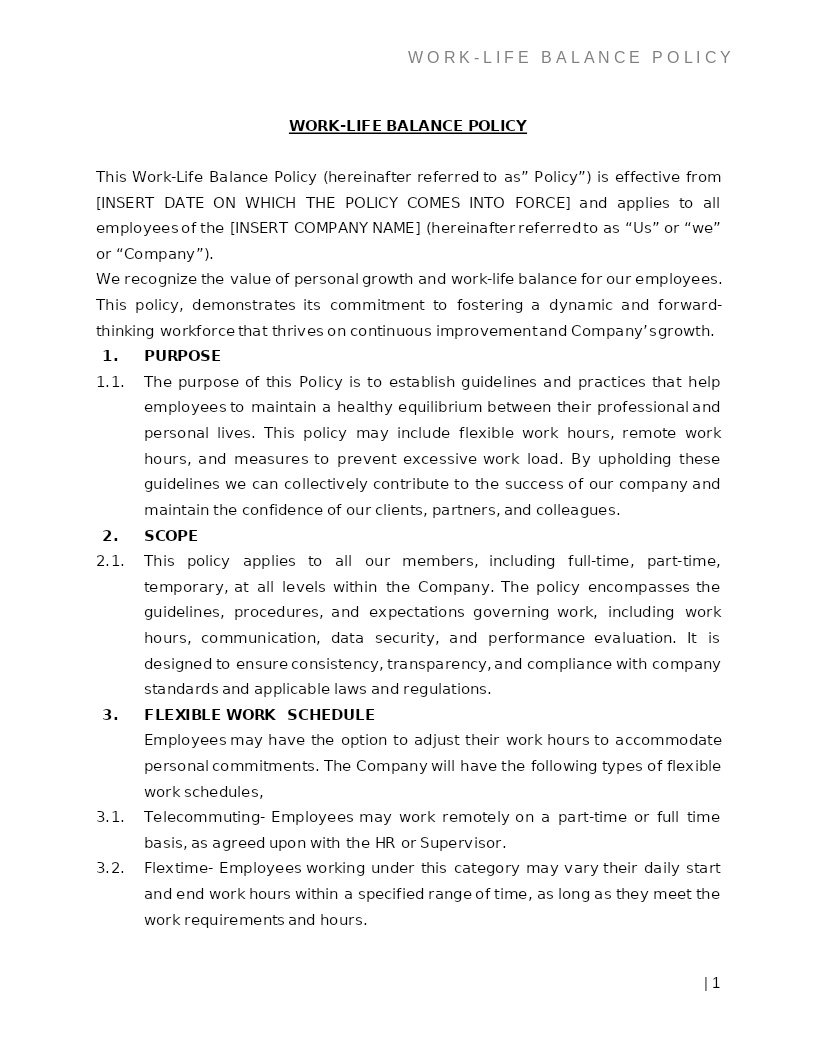
WORK-LIFE BALANCE POLICY
How does it work?
1. Choose this template
Start by clicking on "Fill out the template"
2. Complete the document
Answer a few questions and your document is created automatically.
3. Save - Print
Your document is ready! You will receive it in Word and PDF formats. You will be able to modify it.
Supporting Employee Well-Being and Organizational Productivity
A Work-Life Balance Policy establishes the framework through which an organization supports employees in managing their professional responsibilities while maintaining a healthy personal life. It outlines expectations around working hours, flexibility, time-off practices, remote work guidelines, wellness support, and workload management, helping reduce burnout and increase employee satisfaction and performance.
A well-structured Work-Life Balance Policy creates a culture where employees can thrive both at work and at home. It promotes fairness, reduces turnover, and ensures managers and employees have shared clarity on boundaries, availability, and expectations.
Where Work-Life Balance Policies Are Commonly Used
Work-Life Balance Policies are now standard across a wide range of industries, including:
• Corporate offices and professional service firms
• Hybrid and remote-first organizations
• Retail, hospitality, and customer-facing industries
• Healthcare, education, and nonprofit institutions
• Tech companies, startups, and creative agencies
• Government and public-sector organizations
Different Approaches to Work-Life Balance You May Encounter
- Flexible Working Arrangements: Including remote work options, compressed schedules, part-time work, or flexible hours.
- Paid Time Off & Leave Programs: PTO banks, mental-health days, parental leave, sick leave, and vacation allowances.
- Wellness & Support Programs: Employee assistance programs (EAPs), mental-health resources, onsite wellness initiatives.
- Overtime & Workload Management: Clear expectations around reasonable working hours, overtime limits, and project planning.
- Communication & Availability Rules: Guidelines for after-hours communication and response expectations.
When Legal Guidance Becomes Helpful
Legal review is especially useful when:
• The policy interacts with federal or state labor laws such as the Fair Labor Standards Act (FLSA)
• The organization offers leave programs governed by FMLA or state-specific leave requirements
• The company operates across multiple states with different employment laws
• The policy overlaps with remote-work compliance, wage/hour rules, or health & safety obligations
• The organization wants to align work-life balance with broader HR policies and procedures
How to Work With This Template
• Define working hours, flexibility options, and availability expectations
• Outline time-off rights, leave programs, and required approvals
• Clarify remote work or hybrid eligibility and responsibilities
• Add workload and performance management rules
• Determine how managers should implement the policy fairly
• Review for compliance with U.S. labor standards
• Sign electronically or share through your internal HR platform
Frequently Asked Questions
Q1. Why is a Work-Life Balance Policy important for organizations?
It helps set clear expectations around work hours, flexibility, and time off. A well-designed policy supports employee well-being, reduces burnout, and leads to better productivity and retention.
Q2. Does this policy comply with U.S. labor laws?
Yes. The policy is built around U.S. labor regulations such as FLSA for working hours and FMLA for certain leave entitlements. Companies are encouraged to review state-specific requirements to ensure full compliance.
Q3. Does a Work-Life Balance Policy guarantee flexible schedules?
Not necessarily. It outlines the options available—such as flexible hours, remote work, or compressed weeks—but eligibility depends on job requirements, business needs, and managerial approval.
Q4. How does this policy help prevent employee burnout?
By establishing boundaries around workload, promoting rest, encouraging break times, and setting reasonable expectations for communication outside office hours, the policy helps employees maintain a healthier work rhythm.
Q5. Can employees request remote work under this policy?
Yes, if remote or hybrid work options are offered by the employer. The policy provides guidelines on eligibility, equipment usage, productivity standards, and security obligations for remote workers.
Q6. How does this policy affect overtime requirements?
The policy reinforces compliance with federal overtime rules under FLSA and helps ensure employees are not working excessive or unpaid hours. It guides managers on proper task planning and tracking time.
Q7. Does the policy apply to part-time and contract workers?
In most cases, yes, though specific benefits—like PTO or flexibility—may vary based on employment classification. Employers should specify eligibility clearly in the policy.
Q8. What if workload is too high for employees to maintain balance?
The policy encourages open communication with supervisors, proactive workload planning, and team support strategies to ensure fair distribution of work.
Q9. Can managers contact employees outside of normal hours?
Only when necessary. Many companies include guidelines discouraging after-hours communication unless it is urgent, supporting healthier boundaries.
Q10. How should this policy be communicated to employees?
Organizations typically share it during onboarding, through the employee handbook, and via internal HR systems. Clear communication ensures consistent adoption across teams.