Employer Guide: Key Elements of a Workplace Harassment & Discrimination Prevention Policy (U.S.)
By Yourlegalassistant Team
INTRODUCTION
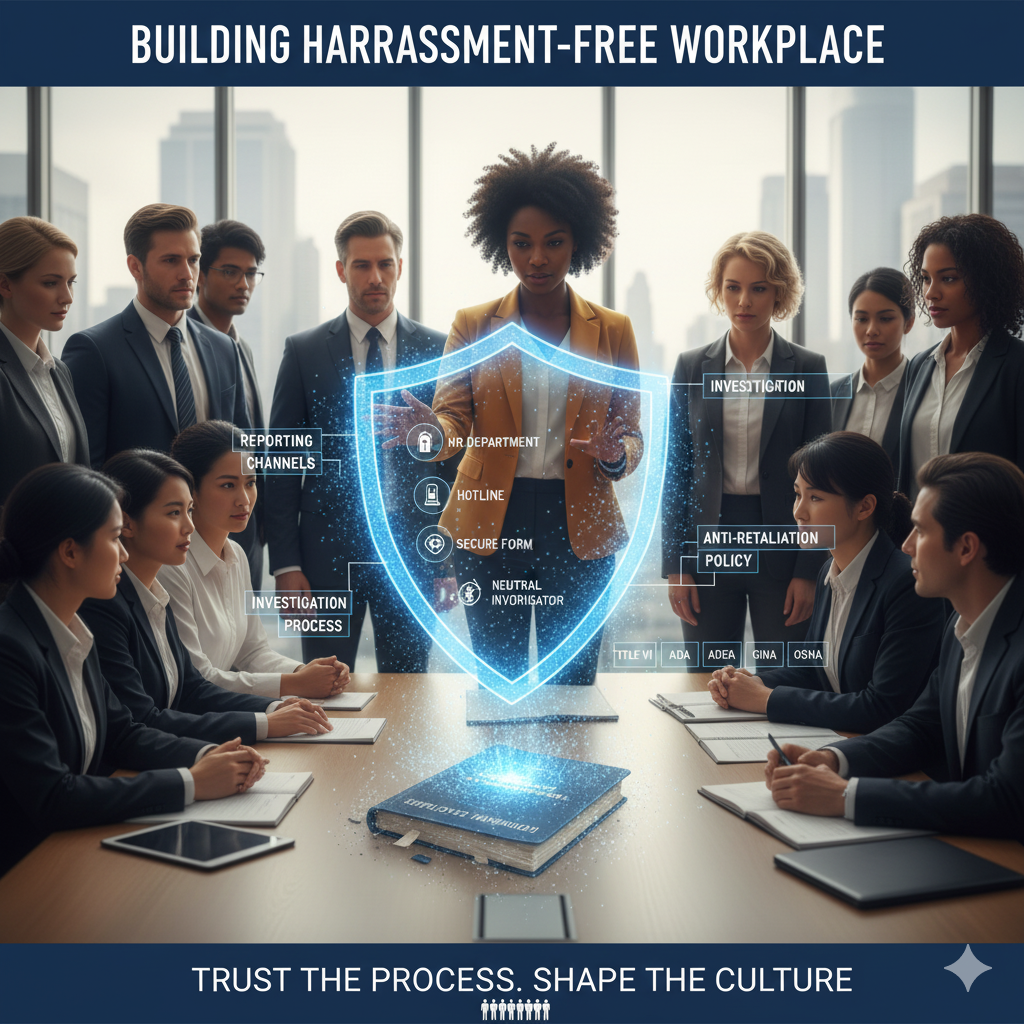
Creating a workplace free from harassment and discrimination isn’t just a legal requirement in the U.S.; it’s a commitment to dignity, respect, and fairness. The most effective policies don’t sit forgotten in an employee handbook - they shape everyday interactions. That means clearly stating what isn’t okay at work, giving people safe and simple ways to speak up, taking a firm stand against retaliation, and handling every complaint with fairness and transparency. When employees can trust the process, the policy actually works - not just exists.
U.S. federal law sets the baseline, and every employer must ensure their policies comply with federal protections under Title VII of the Civil Rights Act of 1964, which bars discrimination based on race, color, religion, sex (including sexual orientation, gender identity, and pregnancy), and national origin. Additional protections flow from the Americans with Disabilities Act (ADA), the Age Discrimination in Employment Act (ADEA), and the Genetic Information Nondiscrimination Act (GINA). Together, these laws safeguard employees from bias related to disability, genetic information, or sexual orientation.
Even workplace safety laws play a role. Under the Occupational Safety and Health Act, employers have to make sure the workplace is safe and, in some situations, a hostile work environment can count as unsafe. In short, a strong policy is both a compliance tool and a cultural foundation: it protects your team, your reputation, and your organization’s future.
HOW TO STATE "HARASSMENT" CLEARLY IN YOUR POLICY
Harassment isn't always loud, obvious, or dramatic; sometimes it’s subtle comments, persistent “jokes,” or behavior that slowly chips away at someone’s dignity. Under U.S. law, workplace harassment is an unwelcome conduct tied to a protected characteristic (like race, sex, religion, disability, or national origin) that either becomes a condition of someone’s job or creates an environment that a reasonable person would find hostile, intimidating, or abusive. In simple terms - If someone feels unsafe, degraded, or pressured at work because of who they are, that’s harassment. A strong policy skips the legal jargon and clearly lists the issues –
like racial or religious slurs, sexual comments or unwanted touching, offensive images, mocking someone’s age or disability, repeatedly mis-gendering someone, or harassment over emails, chats, or social media.
When defining harassment in your workplace policy, keep the language plain, direct, and backed by law. Start by aligning with federal standards under Title VII of the Civil Rights Act, the Americans with Disabilities Act (ADA), and the Age Discrimination in Employment Act (ADEA), which prohibit harassment based on protected characteristics like race, color, religion, sex (including pregnancy, sexual orientation, and gender identity consistent with the Bostock v. Clayton County, 2020’s ruling), national origin, disability, and age. This includes examples such as slurs, unwanted sexual comments or touching, intimidation, offensive images or messages, deliberate misgendering, and harassment through email or social platforms and make clear that conduct must be unwelcome and either severe or pervasive enough to create a hostile work environment under EEOC (Equal Employment Opportunity Commission) guidance. State plainly that retaliation is prohibited and that employees are encouraged to report inappropriate behavior early, even if they're unsure it rises to a legal violation. A policy that combines legal grounding with everyday language builds trust and protects your workplace.
And remember harassment can come from any direction a manager, a coworker, a direct report, a client, or even a vendor. No one is “too junior” or “too senior” to be held accountable.
BUILD A ZERO TOLERANCE CULTURE FOR RETALIATION AND REAL CHANNELS TO SPEAK UP
A harassment-free workplace only works when employees know they can report concerns without fear of payback. Retaliation is the most common complaint filed with the EEOC (Equal Employment Opportunity Commission), which shows that employees aren’t just afraid of the misconduct they’re afraid of what happens if they report it. Under Title VII’s anti-retaliation provisions, employers must protect workers who raise concerns, support a complaint, or refuse to participate in unlawful behavior. Retaliation doesn’t just mean firing someone it can be more subtle - like reducing hours, removing responsibilities, excluding someone from meetings, shifting schedules, or creating social pressure and isolation. Even quiet, indirect actions that discourage reporting can violate the law.
To build trust and stay compliant, your policy should make retaliation an absolute “no,” explain what it looks like, and train managers on their duty to prevent it. Also give employees multiple safe reporting options not only their supervisor, but also HR, a compliance contact, a confidential hotline, or a secure online form. Anonymous reporting options are especially powerful, helping employees come forward early before issues escalate. A credible process includes prompt acknowledgment, a neutral investigation, regular updates, documentation, appropriate action, and protection for everyone involved. When employees believe leadership will listen, act, and safeguard them, they're far more likely to speak up and that strengthens both culture and compliance. In short: don’t just write a policy; build confidence in it.
People don’t report issues just because a policy exists, they do it because they trust the process. Studies, including research shared by Harvard experts, consistently show this: when workers believe leadership will listen and act, they come forward early, and problems get solved before they explode.
The objective is simple: make sure employees feel safe, heard, and respected when they share concerns.
THE FRONT LINE OF LEGAL COMPLIANCE
Managers aren’t just leaders they’re on the front line of legal compliance. Supervisors play a critical role in preventing workplace harassment not just as team leaders, but as legal gatekeepers. Courts have long made it clear when a manager engages in or ignores harassment, the employer can be held responsible. Landmark cases like Faragher v. City of Boca Raton and Burlington Industries v. Ellerth established that employers can be liable for a supervisor’s misconduct, while Vance v. Ball State University clarified that a “supervisor” is someone with real authority over employment decisions, not just a title.
To protect employees and the business, managers must treat every concern seriously, report issues immediately, and model respectful behavior. A strong compliance strategy clear policies, consistent training, prompt investigations, and meaningful corrective action supports the organization’s legal defense and reinforces a culture of accountability. In short, managers aren’t just leaders; they’re key to keeping the workplace safe, fair, and legally compliant. Empower them, train them, and expect action every time.
HOW TO HANDLE WORKPLACE COMPLAINTS THE RIGHT WAY
When someone speaks up, the next steps decide whether your culture feels safe or scary. Build a process employees can trust:
1. Safety comes first
Protect everyone involved immediately adjust schedules, separate parties if needed, or offer paid leave. Support the reporter, don’t sideline them.
2. Keep the investigation neutral
Use a trained, unbiased investigator (HR, compliance, or external). No conflicts. No favoritism. No “they’d never do that.”
3. Focus on facts, not whispers
Gather real evidence:
- Interviews
- Emails, texts, chats, DMs
- Records and video (if available)
- Screenshots & documents
4. Judge credibility fairly
Not every case has clear proof. Look at:
- Consistent stories
- Supporting evidence
- Logic and plausibility
Share that action was taken, apply fair consequences, and follow up to prevent retaliation. Silence destroys trust - communication builds it.
If there are threats or safety concerns, remember OSHA (Occupational Safety and Health Administration) harassment can also be a safety risk.
BUILD A WORKPLACE WHERE EVERYONE CAN PARTICIPATE AND SUCCEED
Inclusion isn’t about slogans it’s about removing barriers so every employee can fully take part and succeed. That begins with clear accommodation practices. Under the Americans with Disabilities Act (ADA), employees have the right to request reasonable support, and your policy should outline exactly how to ask, who handles requests, and the company’s commitment to an interactive, good-faith process. Likewise, privacy matters: the Genetic Information Nondiscrimination Act (GINA) protects genetic and family medical information, so your procedures should avoid requesting it and ensure medical forms use proper safe-harbor language to keep health details private. Age protections under the Age Discrimination in Employment Act (ADEA) mean avoiding age-based assumptions explicit or subtle and holding everyone to the same performance standards. And remember, employees with layered identities may face overlapping risks; modern policies should recognize and address intersectional experiences, consistent with EEOC guidance. True inclusion means anticipating needs, respecting privacy, and ensuring every employee feels supported — not just welcomed, but empowered to thrive.
LEAD WITH ACTION, NOT JUST WRITTEN RULES
A workplace policy only matters if employees see it in action. Don’t let it sit in a handbook - make it visible in onboarding, internal platforms, team meetings, and manager training. Get acknowledgments, but go further by reinforcing expectations regularly. Track meaningful indicators like response times, investigation timelines, documentation quality, follow-up on retaliation concerns, and patterns in complaints. Share high-level trends with leadership — and where appropriate, with staff — to demonstrate transparency and progress. When employees see issues taken seriously and handled fairly, they’re more likely to speak up early. Real trust comes from consistent enforcement, accountability, and proof that leadership treats policy as practice, not paperwork.
LANDMARK COURT DECISIONS THAT SHAPED TODAY’S HARASSMENT RULES
Workplace harassment rules didn’t appear overnight they were shaped through decades of court decisions. Understanding the major Supreme Court cases behind today’s standards helps employers build policies that comply with the law and protect employees.
- Oncale v. Sundowner Offshore Services (1998)
- Same-sex harassment is illegal; what matters is whether the conduct occurred “because of sex.”
- Employer focus: Ensure protections apply to everyone, regardless of gender.
- Faragher v. City of Boca Raton & Burlington Industries v. Ellerth (1998)
- These cases made it clear that employers can be held responsible for harassment by supervisors — even if top management wasn’t aware it was happening. However, companies can protect themselves if they have genuine anti-harassment policies, train managers properly, and act quickly when issues are reported.
- Employer focus: Build real reporting channels and make sure managers understand how to prevent and respond to harassment.
- Vance v. Ball State University (2013)
- Defined “supervisor” as someone with authority over significant employment decisions.
- Employer focus: Clearly identify supervisory roles and train them on responsibilities.
- Bostock v. Clayton County (2020)
- The Court held that discrimination based on sexual orientation or gender identity is discrimination “because of sex” under Title VII.
- Employer focus: Explicitly protect LGBTQ+ employees and uphold inclusive practices.
These cases form the backbone of modern harassment standards. Knowing them helps employers build stronger, fairer, and legally sound workplaces.
CONCLUSION
A harassment and discrimination policy isn’t just paperwork - it’s a promise. Employees don’t judge it by how well it’s written, but by what actually happens when someone raises a concern. Trust is built when issues are acknowledged quickly, investigations are handled fairly and privately, consequences match the behavior, and retaliation simply isn’t an option.
Yes, laws like Title VII, the ADA, ADEA, GINA, OSHA, and key Supreme Court decisions provide the legal roadmap, but culture is what turns those rules into reality. When employees feel safe speaking up, managers understand their duty, and leaders consistently follow through, your policy becomes a living part of the workplace not just legal text.
So don’t let it sit in a handbook. Reinforce it. Train on it. Measure it. Improve it. A policy earns respect when people see it lived out every single day.
For expert guidance on building legally sound workplace policies, navigating U.S. harassment and discrimination compliance, or strengthening your organization’s ethical culture and risk controls, connect with our legal experts at YLA.
FREQUENTLY ASKED QUESTIONS (FAQS):
1. What is considered workplace harassment under U.S. law?
Workplace harassment in the U.S. happens when someone is treated badly or made uncomfortable because of who they are - like their race, gender, age, religion, disability, or sexual orientation. It includes any unwelcome behavior that makes the workplace feel hostile, intimidating, or offensive. Harassment can happen through words, actions, gestures, images, or even online messages.
2. Does workplace harassment include online or digital messages?
Yes. Harassment can happen through emails, chats, text messages, social media, or any digital communication linked to work. Cyber harassment is treated the same as in-person misconduct.
3. Can an employee be retaliated against for reporting harassment?
No. Retaliation for reporting harassment is illegal. Employers cannot punish employees by reducing hours, changing shifts, excluding them, demoting them, or firing them for speaking up.
4. What should employers include in a workplace harassment policy?
A strong policy includes clear definitions of harassment, reporting channels, anonymous reporting options, investigation procedures, anti-retaliation rules, manager responsibilities, and training requirements.
5. Are employers liable if they didn’t know harassment was happening?
Yes, sometimes. Under U.S. law, employers can be held liable if a supervisor harasses an employee, even if management was unaware. Strong policies, reporting systems, and training help build a defense.
6. Why is harassment training important for employees and managers?
Training builds awareness, prevents misconduct, improves reporting confidence, and protects the employer legally. Managers are the first line of compliance and must know how to respond correctly.
7. How can companies create a truly safe and inclusive workplace?
Beyond policies, businesses must model respectful behavior, respond quickly to complaints, protect whistleblowers, and measure accountability. When employees trust the process, culture improves and risk drops.
ABOUT THE AUTHOR
Adv. Sanjana Mishra is a corporate lawyer and legal content strategist specializing in corporate law, contract drafting, and regulatory compliance. She has experience drafting diverse commercial agreements and advising startups. Through YLA, she simplifies legal concepts to help businesses make informed, compliant, and growth-driven decisions.
DISCLAIMER
The information provided in this article is for general educational purposes and does not constitute a legal advice. Readers are encouraged to seek professional counsel before acting on any information herein. YLA and the author disclaim any liability arising from reliance on this content.

Related Articles

Leave a Comment