Master Service Agreements (MSA): What Every Business Owner Should Know
By Yourlegalassistant Team
Introduction
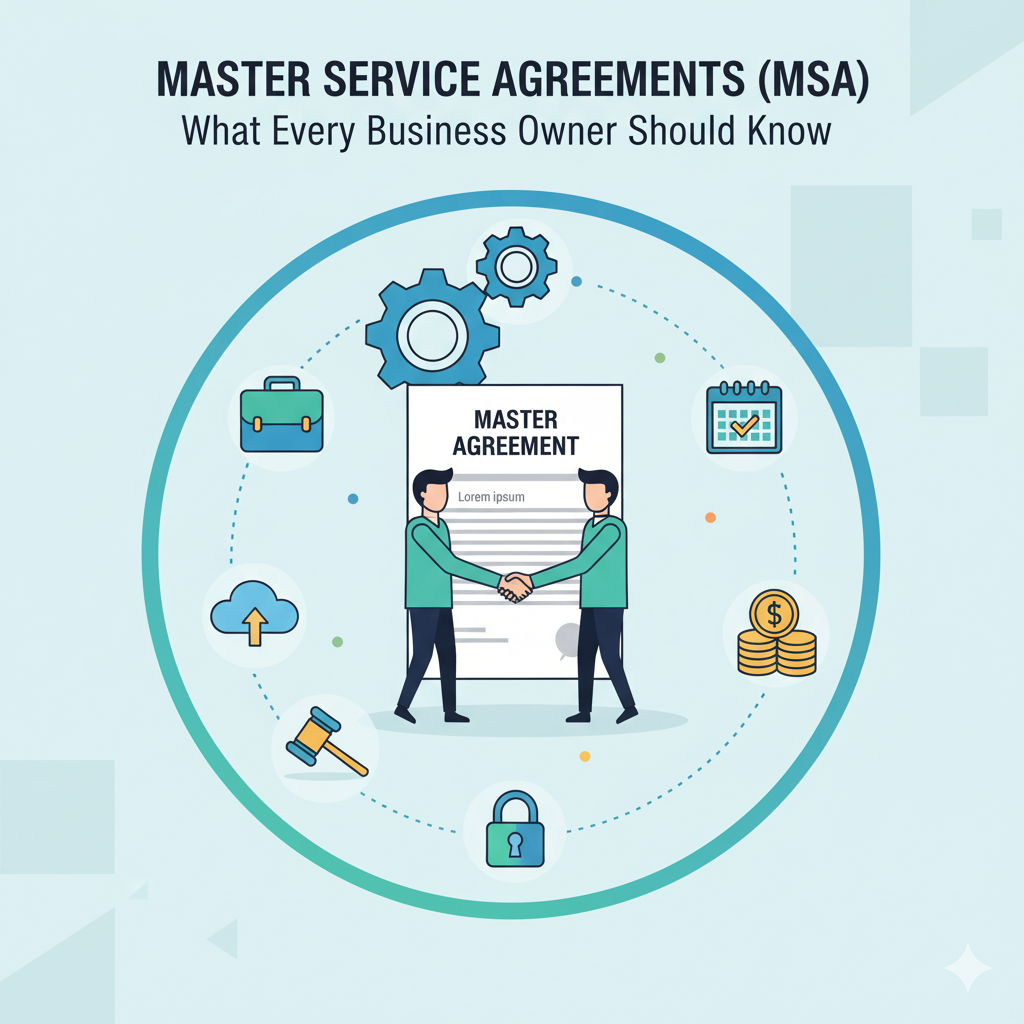
Master Service agreement is a contract that helps businesses in deciding how two parties will work together on present and future projects. It is a foundational contract between two parties typically a service provider and a client that outlines the general terms and conditions governing their future working relationship. Instead of negotiating a new contract every time a service is provided, an MSA establishes the overall framework, allowing projects and services to be executed under Statement of works.
Businesses often come in open-ended relationships with other companies and entities on project-to-project basis. For their assistance, Master service Agreements plays a crucial role when it comes to streamlining business commitments, ownership rights, pricing details, risk mitigation and other important aspects that are necessary for business protection. It contributes to risk management and regulatory compliance especially in industries such as healthcare, finance, and energy.
How a Master Service Agreement Benefits businesses
When an MSA is well drafted, it acts as a shield that reduces risk of legal dispute, minimizes negotiation time and provides for strong legal foundation for smooth operations of businesses. Statement of work (SOW) is an essential document under MSA that outlines scope, timeline, cost and confidentiality among others between two parties, usually a customer and a supplier. It prevents jeopardizing of a contract and benefits the parties for long term where they can focus more on strategic issues rather than recreating standard terms for every engagement.
Speeds up Future contracting
A master service agreement doesn’t need to be negotiated each time. It automatically speeds up future contracting by accurately establishing legal and commercial terms beforehand, which reduces renegotiation each time. SOWs play a major role in ensuring clarity and overview of a project as to what needs to be accomplished by what time.
Provides contractual Consistency
MSA brings contractual consistency to business relationships between parties by standardizing key legal and commercial terms across all projects and transactions between the parties. Instead of renegotiating the fundamental clauses like payment terms, confidentiality and dispute resolution for each engagement, the MSA ensures that these terms remain uniform throughout business partnership.
Reduces Legal Risk
MSA play an instrumental in identifying, assessing, and mitigating risks associated with services outsourced to third parties. It sets a standard framework to manage data breaches, service interruptions, potential risks and non-compliance with regulations. an MSA can outline specific data encryption requirements, incident response procedures, and liability provisions in the event of a data breach. These measures not only help reduce the impact of such incidents but also clearly define each party’s responsibilities and accountability.
Moreover, MSA provides for clear dispute mechanism for resolving conflicts. It is also helpful in improving operational efficiency in various other sectors like energy, finance and food. For example, companies like Chevron have utilized MSA to shield itself from environmental related compliance. Their agreements include provisions for compliance with Environment Protection Agency ( EPA) Standards with detailed mechanisms for dealing with environment hazards.
Improves business relationships and supports long-term collaboration
Long-term partnerships between partners are important for success and growth of an entity. Whether in IT, health, financial or energy sector, there is always some or the other kind of collaboration with third parties. Therefore, MSA is a reliable agreement that navigates the business complexities and parties can rely on its framework. MSA clearly outlines the services provided, scope of work, payment terms and role and responsibilities of the parties that helps in minimizing potential conflicts.
Standard Sections and Key Clauses in an MSA
A well-drafted Master Service Agreement typically includes a set of standard sections and key clauses that form the foundation of the business relationship.
Scope of Work
The Scope of Work section in an MSA outlines the types of services the service provider is expected to deliver and sets the general boundaries for future engagements. While detailed specifications are typically documented in individual Statements of Work (SOWs), this section establishes the overarching framework for what falls within the relationship. It clarifies the nature of the services, the roles of each party, and any limitations or exclusions of the contract.
Work Standards and Service Levels
The Work Standards and Service Levels section of an MSA defines the quality, performance benchmarks, and operational expectations that the service provider must meet throughout the engagement. This may include specific service-level agreements (SLAs), response and resolution times, performance metrics, reporting requirements, and compliance with industry standards or regulatory obligations. By clearly outlining what constitutes acceptable service delivery, this section ensures consistency across all projects and helps prevent disputes arising from differing interpretations of quality.
Payment Terms and Conditions
MSA provides for a clear financial framework for the services provided, where both parties have a clear understanding of how and when payments will be made. The section clearly outlines the pricing structure, invoicing frequency, payment methods, due dates, and any applicable taxes or reimbursable expenses.
This clause is very crucial for smooth operations of businesses as it establishes a transparent and consistent financial rule upfront, the payment terms help prevent misunderstanding, smooth cash flow management, and create a fair billing process for both parties.
Confidentiality Provisions and Intellectual Property Rights
Confidentiality is a fundamental component of any MSA, as it safeguards a company’s proprietary rights and innovation in the long run. Similarly, IP rights clause clearly outlines the ownership, usage and licensing of any intellectual property created under this agreement. These are crucial component of MSA as they establish a clear guideline for handling sensitive information to protect trade secrets and business strategies.
Termination
An MSA outlines the circumstances under which either party may end the agreement and the procedures that must be followed. It typically includes provisions for termination for convenience, termination for cause such as a material breach and any required notice periods. This section may also address obligations that survive termination, like confidentiality, payment for completed work, and the return of materials or data.
Indemnification and limitation of liability
Indemnification and limitation of liability are both used to manage and mitigate risks in contracts; however, their purposes differ. Limitation of liability clause protects parties from potential liability arising from breach of contract or negligence. An indemnification clause does the job of transferring the liability. It requires one party to compensate the other for any losses or damages incurred in the business.
Governance and dispute resolution
The governing law clause clarifies as to which jurisdiction’s legal framework will govern the contract in case of disputes between the parties in the business. The dispute resolution clause addresses as to how the parties will address conflicts between parties. This clause specifies alternative methods such as negotiation, mediation, or arbitration. It may often identify the governing law and jurisdiction. This clause helps minimize misunderstanding and encourages quicker settlements, ultimately preserving business relationships.
What are some common MSA related challenges that businesses face
Among various challenges, some common challenges have been discussed below that businesses should keep in mind while constructing and amending their MSA.
Complexity in managing amendments and tracking updates
Managing amendments and tracking updates under an MSA can become complex, especially when multiple Statements of Work or change orders are involved. Over time, different versions of documents, revisions to pricing, updated service descriptions, or modified terms can create confusion if not properly organized. Without a clear version-control process and centralized documentation, teams may rely on outdated clauses or miss critical updates, leading to operational errors or contractual disputes. This complexity makes structured contract management essential to maintain clarity and to ensure that all parties are aligned throughout the business relationship.
Poor integration with operational teams
Poor integration with operational teams is a frequent challenge in the implementation of MSAs. While legal and business leaders may understand the terms negotiated in the agreement, the teams responsible for day-to-day execution such as project managers, service teams, and finance personnel may not be fully aware of their obligations. This disconnect can result in missed deadlines, non-compliance with service standards, or failure to follow contractual processes like approvals, reporting, or change management. When operational teams do not clearly understand the MSA’s requirements, even well-drafted agreements can fail in practice, leading to service disruptions, strained relationships, and avoidable disputes. Effective communication and internal alignment are therefore essential to ensure the MSA is followed consistently across all functions.
Unstructured MSAs are risky and expensive
When MSA lacks clarity and consistency in its format, it leaves gap for compliance failure, unexpected financial liabilities and services delays which can lead to disputes among parties. Therefore, poorly constructed MSAs are not only risky, but they are also expensive and can mire businesses in long term legal disputes.
Role of AI and technology in MSA Enhancement
The integration of AI and technology plays a catalyst for efficient MSA drafting. AI is transforming the way organizations draft, manage, and enforce Master Service Agreements. It is feasible to make use of AI in modern contract management platforms to automate repetitive tasks such as document review, version comparison and compliance checks, significantly reducing time and effort required to prepare MSAs.
Machine learning tools can identify risks, missing clauses and suggest optimized language based on industry standards. By leveraging AI-driven insights, businesses can enhance accuracy, reduce human error, improve compliance, and maintain data driven MSA management processes.
Conclusions
A Master Service Agreement is the backbone of an efficient and long-term business relationship. By laying out clear terms in advance, an MSA reduces repetitive negotiation, accelerates future contracting, and creates a consistent framework for managing multiple projects. It requires careful drafting to avoid common challenges such as ambiguity, version-control issues, and poor operational alignment.
When designed thoughtfully and communicated effectively across teams, an MSA becomes a powerful tool that minimizes risk, strengthens collaboration, and ensures smoother project execution. For any business engaging in ongoing services, contract tracking, and management of these components is as crucial as the agreement.
Frequently asked Questions (FAQs)
1. Who should use a master Service Agreement?
MSAs are particularly valuable when a business anticipates multiple projects with the same vendor or client over an extended period and need recurring services from the same provider. It provides standardize terms across multiple divisions or departments
2. When to use an MSA?
An MSA is best used in situations where there is an ongoing or long-term business relationship. It is most used in the following scenarios:
· Ongoing Service Agreements
· Multi-Project Engagements.
· Complex Relationships
· Contractor or Vendor Relationships
3. What is the main purpose of master-service agreement?
An MSA outlines the terms and conditions that govern a long-term business relationship, reducing the need to draft a full contract for each new engagement. It includes provisions on payment terms, warranties, termination rights, indemnification, dispute resolution, and limitations of liability
4. What is the difference between a master service agreement and a statement of work?
A Master Service Agreement (MSA) sets the overall legal and commercial framework for a long-term business relationship. It includes general terms such as payment provisions, warranties, confidentiality, liability limits, dispute resolution, and termination rights. In contrast, a Statement of Work (SOW) is a project-specific document that outlines the details of a particular engagement under the MSA.
5. Are MSA legally binding?
Yes, a Master Service Agreement (MSA) is legally binding once it is signed by both parties. Like any contract, an MSA creates enforceable obligations and defines the rights, responsibilities, and liabilities of each party. If the agreement meets standard legal requirements such as mutual consent, lawful purpose, clear terms, and consideration it holds full legal force. Any Statements of Work (SOWs) executed under the MSA are also legally binding and operate within the framework established by the MSA.
6. What are risks of not having an MSA in place?
Not having an MSA in place exposes a business to several significant risks. Without a clearly defined framework, both parties may have different expectations regarding responsibilities, payment terms, service standards, and ownership of deliverables, which can quickly lead to misunderstandings or disputes.
7. What clauses are important in a Master Service agreement?
A Master Service Agreement includes several key clauses that define the business relationship. Important sections typically cover the scope of services, payment terms, confidentiality, data protection, and intellectual property rights. It also includes clauses on indemnification, limitation of liability, warranties, dispute resolution, term and termination, and change management.
8. Can MSA be used for international business relationship?
Yes, an MSA can be used for international business relationships, and it is commonly done in global operations. However, when used across borders, the agreement must be carefully drafted to address additional complexities such as differing legal systems, tax rules, data protection requirements, and import/export regulations. Key considerations include choosing the governing law, jurisdiction, and dispute resolution mechanisms, as well as ensuring compliance with international standards like GDPR for data protection.
ABOUT THE AUTHOR
Jyoti Singh is a Corporate Lawyer with expertise in business law, regulatory compliance, and Contract management. She is passionate about simplifying legal concepts for entrepreneurs and professionals, empowering them to make informed and responsible business decisions. Through her work and writing at YLA, she aims to bridge the gap between law, business strategy, and sustainability.
DISCLAIMER
The information provided in this article is for general educational purposes and does not constitute a legal advice. Readers are encouraged to seek professional counsel before acting on any information herein. YLA and the author disclaim any liability arising from reliance on this content.

Related Articles

Leave a Comment