From First Draft to Final Deal: How to Negotiate Contracts Like a Pro
By Yourlegalassistant Team
INTRODUCTION
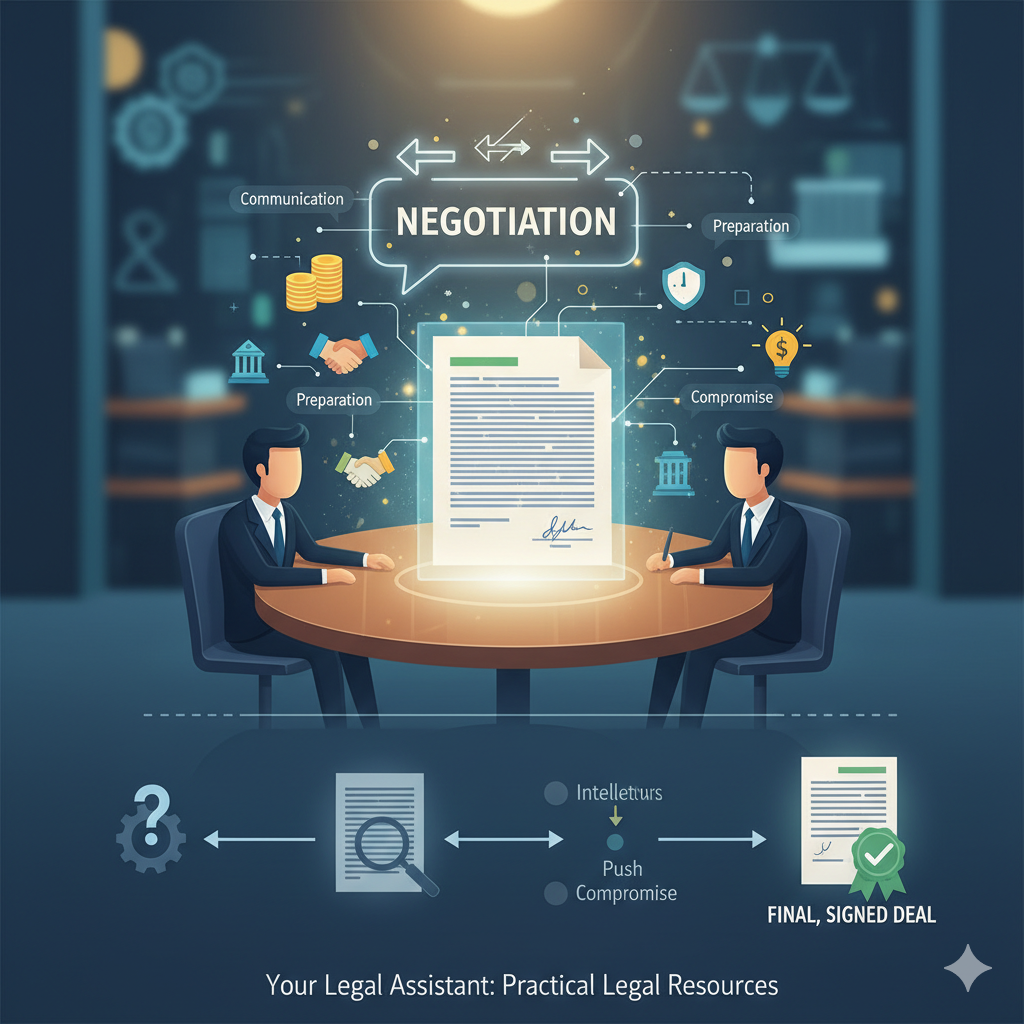
Contracts are the backbone of modern business they shape relationships, define expectations, and protect your enterprise from legal or financial setbacks. For startups and small businesses, every signature holds weight. Yet, many entrepreneurs admit to feeling lost when faced with dense legal documents filled with unfamiliar terms. The art of contract negotiation is not about confrontation; it’s about communication, preparation, and protecting your interests.
This comprehensive guide explains how you can approach contract negotiations strategically, avoid common pitfalls, and confidently go from the first draft to the final, signed deal no law degree required.
WHAT IS NEGOTIATION?
Before you can negotiate a contract effectively, it’s essential to understand what negotiation truly means.
Negotiation is a strategic dialogue between two or more parties aimed at reaching a mutually beneficial agreement. It’s not about winning or overpowering the other side, it’s about finding balance, building trust, and ensuring clarity. In business, negotiation helps align expectations, clarify terms, and prevent conflicts down the road.
A good negotiation involves communication, preparation, and compromise. It requires understanding both your objectives and the other party’s priorities to create solutions that serve everyone’s interests.
WHAT IS CONTRACT NEGOTIATION?
Contract negotiation is mainly the process of analyzing and agreeing on the terms of a contract before it's rendered legally enforceable. Before they sign on the line of intent, two or more parties collaborate to make sure the contract reflects their shared expectations, responsibilities, and protections.
In simpler terms, it's about maintaining a balance. The best contracts are those in which both parties leave feeling safeguarded and assured of what is expected of them, even though each party desires to secure better terms.
Whether a startup signs its first vendor agreement, a marketing agency onboards a client, or a tech company licenses software to a partner, contract negotiation is essential to all commercial interactions in the United States. Through negotiation, it is ensured that all parties' interests are taken into consideration and that the agreement conforms with applicable laws, such as the Uniform Commercial Code (UCC) and state-specific contract principles.
WHY CONTRACT NEGOTIATION MATTERS FOR SMALL BUSINESSES
Contracts are essential to trade in the United States, where over 33 million small firms operate, according to the U.S. Small Business Administration (SBA). They serve as the legal cornerstone of contracts involving clients, vendors, employment, and investments. A poorly negotiated contract may limit your rights, create ambiguities, or put you at unnecessary risk. For instance, ambiguous scope-of-work clauses sometimes result in disagreements over deliveries, a problem that costs companies thousands of dollars in legal bills every year.
Conversely, a well-crafted contract provides protection and clarity. It guarantees that both parties are aware of what is expected of them, how success is determined, and what options are available if commitments are not fulfilled. This enhances long-term commercial ties while also fostering trust.
1. Preparation: The Foundation of Every Successful Negotiation
Effective negotiators set themselves apart from mediocre ones through preparation. Establish your goals before you even go over a draft. Determine your top priorities, including terms of payment, deadlines for deliverables, ownership rights, and liability restrictions. Next, consider the priorities of the opposing side. This will enable you to develop ideas that will satisfy both parties.
The Harvard Program on Negotiation states that the BATNA technique, or your "Best Alternative to a Negotiated Agreement," is a helpful framework. You can avoid accepting poor terms out of fear of losing the deal by being aware of your BATNA.
Prior to engaging, make a negotiation checklist. Make a list of your ideal terms, possible trade-offs, and deal-breakers. This framework reduces your tendency to make impulsive choices and keeps you impartial during heated conversations.
2. Understanding the Anatomy of a Contract
Most contracts have a standard format, though they differ depending on their intended use. You can determine what to concentrate on and where the risks are by comprehending the structure of a typical business contract.
Important elements consist of:
i. Parties and Introduction: Clearly states who is entering into the agreement
ii. Scope of Work (SOW): Specifies deliverables, deadlines, and quality standards.
iii. Payment Terms: Describes the manner and timing of payments.
iv. Intellectual Property (IP): Outlines who owns any creative or proprietary output.
v. Confidentiality: Protects sensitive business information.
vi. Liability and Indemnity: Assigns accountability for damages or losses.
vii. Termination Clause: Details how and when the contract can end.
viii. Dispute Resolution: Determines whether disagreements will be settled through arbitration or in court.
3. Prioritize Clauses That Have the Greatest Business Impact
Not all clauses are created equal. Certain clauses have a direct impact on small businesses' daily operations and profitability. Prioritize these clauses over less important ones.
For instance,
i. Payment Terms: cash flow is crucial when it comes to payment terms. Insist on prompt payment schedules and late fee provisions.
ii. Limitation of Liability: Prevents being held responsible for damages disproportionate to your contract value.
iii. IP Ownership: If you're a tech or creative startup, you should keep your intellectual property rights unless you get paid in full.
iv. Termination Rights: If the partnership no longer benefits your company, make sure you can end it without incurring severe penalties.
State-by-state legal guidelines for sales and business contracts are established under the Uniform Commercial Code. Knowing these guidelines guarantees that your contracts meet federal and state requirements.
4. Redlining and Reviewing: The Professional Way to Negotiate
When reviewing a contract draft, redlining allows you to propose edits transparently. This process is standard practice, especially in commercial deals. Your edits should always include justifications this signals collaboration, not conflict.
For instance, instead of deleting a liability clause, consider rewording it to limit exposure. Professional tone and clarity facilitate faster, more productive negotiations, according to the American Bar Association (ABA).
5. Knowing When to Push and When to Compromise
In negotiations, confidence and adaptability must be balanced. While making compromises too soon may weaken your position, insisting on every demand could drive the other side away.
When it comes to provisions that could endanger your company, like those pertaining to liability or intellectual property transfer, be tough. On operational specifics, such as reporting frequency or small warranties, keep an open mind. Long-lasting relationships are created when both parties feel valued, as the Forbes Business Council points out.
6. U.S. Contract Law Basics
Contract law in the US is a combination of codified statutes and common law concepts intended to encourage predictability and fairness in business transactions. The Uniform Commercial Code (UCC) governs contracts involving the sale of commodities across states, while common law governs the majority of service contracts, such as employment, consultancy, and partnership agreements. This combination permits flexibility for state-specific interpretations while ensuring uniformity in business transactions.
Any contract must meet five fundamental requirements in order to be enforceable:
i. Offer: A precise proposal made by one side that describes the conditions of the deal.
ii. Acceptance: The opposite party's clear consent to those conditions.
iii. Consideration: A valuable item, like cash, products, or services, that is traded between the parties.
iv. Capacity: Both parties must be of legal age and sound mind.
v. Lawful Purpose: The goal of the contract cannot contravene any laws or public policies.
When deciding whether an agreement will stand up in court, each of these elements is crucial. For instance, a contract lacking proper consent or involving unlawful subject matter (such as unlicensed activities) may be declared void. Each component is explained in detail in resources from the Legal Information Institute at Cornell Law School.
7. U.S. Case Laws Every Business Owner Should Know
i. Singh v. T‑Mobile (2nd Dep’t, Nov. 13 2024)
In this New York case, the court looked at how an apparently common merger clause or change-of-control language in a management agreement permitted the big company (T-Mobile) to abruptly end a minority partner's contract. The decision emphasizes how boiler-plate or concealed terms, such as merger or change-of-control clauses, can have a big impact on smaller parties in discussions.
When negotiating with larger companies, small enterprises or startups should pay particular attention to clauses pertaining to automatic shifts in obligations, termination rights triggered by mergers, or changes in control. During the negotiating stage, these are frequently disregarded.
ii. Machuca v. Collins Building Services, Inc. (NY App. Div., Mar. 13 2024)
A third-party beneficiary claim based on a contract that included comprehensive statutory compliance language (including prevailing wage standards) was permitted by the court in this employment/services contract scenario. The ruling demonstrates how a contract's generic "compliance with law" provision can give non-signatory third parties enforceable rights.
Strong procedural language, such as "compliance with all applicable federal and state laws," can lead to third-party claims when designing or negotiating contracts. Make sure you are aware of the consequences of using wide language.
8. Get a Legal Review Before Signing
Important details concealed in complicated contract wording might be missed by even the most seasoned business executives and entrepreneurs. Although legal documents are purposefully exact, non-lawyers may find it challenging to understand them. One ignored phrase can have expensive repercussions down the road, such as an indemnity clause, an automatic renewal term, or a jurisdiction requirement.
Because of this, it is not only advised but also necessary to have an attorney analyze your contract before signing. A knowledgeable contract lawyer ensures that the agreement is in line with your company's goals and conforms with any applicable state or federal regulations by using their trained eye to identify unclear or biased language.
Legal review also helps you:
i. Clarify ambiguous language that might be open to multiple interpretations.
ii. Identify hidden risks, such as personal liability or unfavorable indemnity clauses.
iii. Ensure regulatory compliance, especially in industries with specific legal standards like data privacy, employment, or intellectual property.
iv. Balance commercial terms so that neither party is unfairly disadvantaged.
Legal counsel doesn't have to be prohibitively expensive for new and small enterprises. These days, a lot of attorneys and online legal service providers offer flat-fee contract evaluations, in which a lawyer will analyze your contract, make recommendations for changes, and define important words in simple terms.
To put it briefly, get anything legally binding professionally reviewed before signing it. You can avoid serious legal and financial risks later on with that little upfront effort and money investment. With the help of a lawyer, your contract becomes more than just a document it becomes a real defense of your company's interests.
9. Managing Your Contracts After Signing
Many companies make the error of putting the contract away and moving on once the signatures are on paper (or digitally). However, contract management actually starts after signing, not before. The implementation and supervision of a well-negotiated agreement determine its effectiveness.
Active post-signature management guarantees that deadlines are fulfilled, possible risks are resolved before they become disputes, and both parties keep their end of the bargain. Additionally, it enables you to effectively monitor performance indicators, compliance requirements, and renewal schedules, assisting you in maintaining legal and business protection throughout the contract's duration.
Time-sensitive requirements, such as payment schedules, delivery milestones, confidentiality clauses, renewal dates, and termination notice periods, are included in every contract. Financial penalties or inadvertent contract renewals could arise from missing any of these deadlines.
In short, accountability, consistency, and proactive supervision are key components of managing your contracts once they are signed. When done correctly, it turns legal documents into a functional framework that fosters development, reduces risk, and creates enduring trust with your partners.
CONCLUSION
Clarity, equity, and long-lasting connections are more important in contract negotiations than winning or losing. You can safeguard your company from danger and provide the groundwork for long-term growth by approaching each agreement with readiness, comprehension, and strategic communication.
Every contract may be transformed from a legal formality into a strategic business tool by taking the time to carefully negotiate, regardless of your level of experience as an entrepreneur.
For more insights on business contracts and negotiation best practices, visit Your Legal Assistant your trusted guide to practical legal resources for U.S. businesses.
FAQs
1. What is a Contract Negotiation?
The process of debating and settling a contract's terms before it becomes enforceable is known as contract negotiation. It enables all parties to define responsibilities, establish reasonable terms, and handle possible hazards. Businesses usually go over important conditions including payment terms, deliverables, confidentiality, liability, and termination rights during negotiations. The objective is to draft a fair agreement that safeguards the interests of all parties. Once both parties agree and sign, the contract becomes legally enforceable under U.S. contract law.
2. What are the most important clauses to negotiate in a business contract?
Payment terms, scope of work, termination rights, limitation of liability, intellectual property ownership, and confidentiality are among the most important clauses to go over. These have a direct effect on the operations, finances, and legal risk of your company. Make sure the contract specifies what happens in the event of missed deadlines or late payments. It's important to carefully negotiate these conditions or obtain a legal review before signing because minor adjustments might greatly lower your risk.
3. How can startups protect themselves during contract negotiations?
Startups can safeguard themselves by clarifying intellectual property ownership early on, restricting liability, and adopting straightforward language. If a collaboration no longer advances your objectives, include termination clauses that provide you freedom. To ensure impartiality, look up common words used in the sector. Maintaining uniformity across several transactions can also be facilitated by using a template that has been examined by a lawyer. Give priority to terms that affect future rights and cash flow rather than just the immediate worth.
4. How can I negotiate a contract in a professional manner?
Being prepared is the first step in negotiating like an expert. Establish your objectives, specify what cannot be compromised, and learn what the other party values most. Make sure that the terms of payment, deliverables, and liability limits are all clear. Instead of making decisions based on feelings, base your negotiation on justice and the facts. Maintaining structure is aided by using a checklist and going over previous agreements. Before signing, speak with a business lawyer to safeguard your interests if the deal is complicated.
5. As a consultant or freelancer, how can I improve my negotiating position?
Before creating the contract, use a well written proposal to bolster your position as a freelancer. Indicate the deliverables, due dates, and terms of payment. Incorporate terms of IP ownership and late fees. To bolster your reputation, emphasize your track record and customer outcomes. Even with big corporate clients, your negotiating power increases with the amount of value you exhibit.
6. What is the difference between negotiation and contract negotiation?
Negotiation is a broad process where two or more parties discuss terms to reach a mutually beneficial understanding it could involve pricing, partnerships, or timelines. However, Contract Negotiation is a more formal stage focused on finalizing a written agreement that becomes legally binding once signed.
7. What happens if a business contract is breached?
If a business contract is breached, it means one party failed to meet their agreed obligations such as missing payments, deadlines, or deliverables. The other party may seek legal remedies like financial compensation, specific performance, or termination of the agreement.
Most contracts outline how disputes will be resolved, often through arbitration or mediation under the Federal Arbitration Act
AUTHOR BIO
Pooja Joshi is a corporate lawyer specializing in business contracts, corporate governance, and compliance strategy. She has worked extensively with developing firms and legal-tech platforms, preparing and analyzing a wide range of agreements, from vendor contracts and NDAs to high-value M&A negotiations. Her writing blends legal precision with practical insight, helping make complex legal concepts more accessible to People from non legal background.
DISCLAIMER
The information provided in this article is for general educational purposes only and does not constitute legal advice. Readers are encouraged to seek professional counsel before acting on any information herein. Your Legal Assistant (YLA) and the author disclaim any liability arising from reliance on this content

Related Articles

Leave a Comment