E-COMMERCE & WEBSITE TERMS OF SERVICE: LEGAL REQUIREMENTS FOR U.S. BUSINESSES
By Yourlegalassistant Team
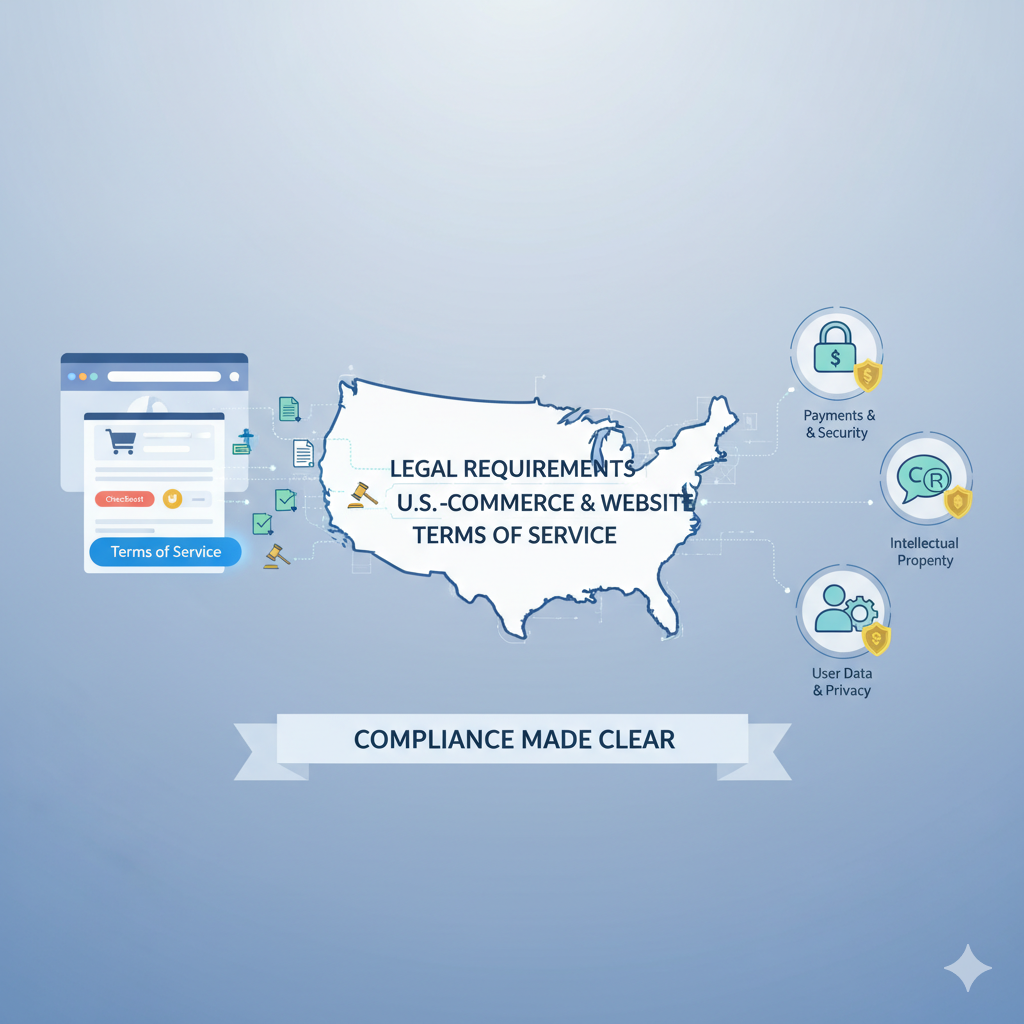
INTRODUCTION
If your revenue touches the internet, your Terms of Service (ToS) are not a formality, they’re the backbone of how you form contracts, take payments, market to customers, resolve disputes, protect data, and even collect tax. In 2025, regulators and courts have sharpened the rules on subscriptions, online assent, kids’ privacy, accessibility, and sales-tax nexus. Below is a crisp, practical guide to the U.S. legal requirements your ToS and related policies should reflect. Set up your ToS in a way that founders, product managers, and lawyers can easily put everything together without making unnecessary mistakes.
1. CONTRACT FORMATION ONLINE: MAKE USER CONSENT CRYSTAL CLEAR
In the digital world, courts only enforce online Terms of Service when users clearly see the terms and actively agree to them. Simply burying your ToS link in a website footer (browsewrap) won’t cut it anymore. Instead, courts consistently favor clickwrap or sign-in wrap models, where users must take an affirmative action and are visibly informed, they’re agreeing to your terms.
a) How to Build a Legally Strong ToS Flow
- Place a plain and obvious consent statement right above your primary button.
- Example: “By clicking Sign Up, you agree to our Terms of Service and Arbitration Agreement (including Class-Action Waiver).”
- Make your ToS and Arbitration links stand out (bold, underline, contrasting color).
- Use a mandatory checkbox for sensitive terms, like:
- Arbitration
- Auto-renewal billing
- Sharing personal data
- Maintain evidence of consent: store screenshots of each ToS version and logs showing user date/time, IP, device, and click actions.
Courts want proof that users didn’t just pass by your terms, they actively agreed to them. In other words, users should clearly “say yes,” not silently slide past your policies.
Leading judicial precedents
- Nguyen v. Barnes & Noble (9th Cir. 2014)
- Website lost enforcement because terms were merely hyperlinked near buttons without any clear assent.
- Meyer v. Uber (2d Cir. 2017)
- Arbitration clause upheld because the sign-up screen clearly alerted users that clicking “Register” meant agreeing to the terms.
- Berman v. Freedom Financial (9th Cir. 2022)
- Court clarified the gold standard:
- Conspicuous notice + clear user action = enforceable online agreement.
b) Subscriptions, free trials & auto-renewals
If your business offers subscriptions, free-to-paid trials, memberships, or recurring billing, your Terms of Service and checkout flow must follow strict U.S. subscription laws. These rules are designed to make sure customers know what they’re signing up for—and can leave just as easily.
Federal Rules: ROSCA (15 U.S.C. § 8401 et seq.)
Under the Restore Online Shoppers’ Confidence Act, businesses must:
· Clearly explain recurring charges before collecting payment
· Get explicit consent (no pre-checked boxes)
· Provide a simple, fast way to cancel, not a confusing obstacle course
FTC “Click-to-Cancel” Rule - 2025 Update
The FTC approved a rule in 2024 requiring companies to let users cancel online in just a few clicks.
Although a federal appeals court put the rule on hold in July 2025, companies are still encouraged to follow it. If signing up takes one minute, canceling shouldn’t take ten. Sticking to this standard protects customer trust and reduces legal risk.
California’s Auto-Renewal Law (Bus. & Prof. Code §§ 17600-17606) sets the bar even higher:
· Tell users the subscription terms before they buy
· Get clear consent to auto-renew
· Send confirmation emails with terms included
· Provide easy online cancellation (no phone calls required)
· Send renewal reminders for long-term plans
If your business touches California customers, even once then these rules matter.
Quick ToS Checklist for Subscriptions
At signup, clearly show:
· Trial length
· Billing cycle
· Price after the trial
· How to cancel (ideally in two clicks or less)
Operational best practice:
· Keep records showing when/how users agreed
· Store cancellation proof
c) E-signatures & paperless records
Online agreements and e-signatures are legally valid in the U.S. But to make them enforceable, you must follow a few key rules, especially when dealing with consumers.
E-SIGN Act (15 U.S.C. § 7001 et seq.)
Under federal law, electronic signatures and records are just as valid as paper ones.
But for consumer agreements, you must:
· Get clear consent to deliver documents electronically
· Tell users what devices or software they need to access them
Think of it as making sure the user actually knows they're signing online—and can read what they're agreeing to. Most states also follow the Uniform Electronic Transactions Act, which backs up the same rules for digital agreements. Add a clause in your ToS called “Electronic Communications & Notice” to confirm users agree to receive documents and notices electronically.
d) Privacy & children’s data: protect what you collect
Your Terms of Service and Privacy Policy must tell the same story and your practices must actually follow it.
Kids’ Data: COPPA Compliance
If your site or app collects info from children under 13, the Children’s Online Privacy Protection Act (COPPA) requires you to:
· Post a clear privacy notice
· Get verifiable parental consent
· Allow parents to review/delete data
· Collect only what you truly need
· Keep children’s data secure
This applies to platforms aimed at kids or any service that knows kids under 13 are using it.
Even if you’re not based in California, you must comply if CA residents use your site.
CalOPPA (BPC §22575) requires you to:
· Display a visible privacy policy
· Explain what data you collect/share
· Disclose Do-Not-Track practices
· Show when your policy was last updated
These are some of the toughest privacy rules in the U.S. and they set the standard many states follow. Link your ToS and Privacy Policy and make sure they don’t contradict each other. For example, don’t promise privacy in one place and try to waive responsibility in another.
e) MARKETING DISCLOSURES, EMAIL & SMS
• Online Advertising: Under the FTC’s “.com Disclosures,” any important information in your ads must be easy to spot and placed right next to the claim, no hiding details in tiny fine print. This applies to everything from product pages to influencer posts.
• Email Marketing (CAN-SPAM Act): Your emails must be honest and straightforward. Use real subject lines, include your business’s physical address, and give users an easy unsubscribe option that you honor within 10 business days.
• Texts & Calls (TCPA): Marketing texts require prior express written consent, and you must follow Do-Not-Call rules. The FCC’s latest update stresses that each person on the DNC list needs their own individual consent. Make sure your SMS terms reflect this and keep solid records of every opt-in.
f) ACCESSIBILITY (ADA)
The DOJ has made it clear that any business serving the public must ensure its website is accessible under ADA Title III. This means your site should follow WCAG accessibility standards and your ToS or Accessibility Statement should reflect that commitment. It’s also important to offer an easy, accessible way for users including those with disabilities, to get support or request help
g) SALES-TAX
After the South Dakota v. Wayfair (2018) ruling, states can now require online businesses, even those located elsewhere, to collect sales tax once they pass certain sales or transaction limits. To avoid confusion, your ToS should clearly explain whether your prices include tax and let customers know that the final amount at checkout may change based on the tax rules in their state.
PUTTING IT ALL TOGETHER:
Here’s a quick guide to the key sections every U.S. business should include in its Terms of Service. Use clear headings, keep the language easy to understand, and link important policies where users can easily see them.
- Acceptance of Terms & Electronic Communications: Tell users that by using the site, they accept your terms and agree to receive information electronically (E-SIGN/UETA).
- Account & Eligibility: Set age requirements, include COPPA language for under-13 users, and mention parental consent where needed.
- Pricing, Free Trials & Auto-Renewal: Clearly show trial length, renewal pricing, billing cycle, and how to cancel. Follow ROSCA and California’s auto-renewal rules.
- Refunds & Returns: Match your policy with FTC shipping rules if you sell physical goods.
- User Conduct & IP: Outline acceptable behavior and reference your DMCA(Digital Millennium Copyright Act) policy for copyright issues.
- Arbitration & Governing Law: Highlight any arbitration or class-action waiver terms and make them highly visible, ideally near the sign-up button.
- Privacy & Cookies: Link to your Privacy Policy and reflect CCPA/CPRA rights, Do-Not-Track, and Global Privacy Control requirements.
- Marketing Messages: Explain email/SMS consent, how users can opt out, and follow CAN-SPAM and TCPA rules.
- Accessibility: Commit to WCAG standards and provide an accessible way for users to get help.
- Taxes: Let customers know that sales tax may be added based on their state, especially after Wayfair.
CONCLUSION
A strong Terms of Service doesn’t rely on complicated legal wording, it’s built on clarity, transparency, and good user experience. If you make user consent clear, explain subscriptions and cancellations upfront, follow privacy rules (especially for children and California users), get proper marketing consent, ensure accessibility, and handle sales tax honestly, you’ll create a ToS that truly supports your business. The best strategy is to build these requirements into your product design and development from the start, so compliance naturally becomes part of every feature rather than something you fix later.
For expert support in drafting compliant Terms of Service, creating legally sound privacy and subscription policies, or ensuring your online business meets U.S. federal and state regulatory standards, connect with our legal team at YLA.
FREQUENTLY ASKED QUESTIONS (FAQS):
1. What makes an online agreement legally enforceable?
Courts look for two things: clear notice of your terms and clear user action (like clicking “I agree”). Hidden links or buried terms won’t hold up.
2. Are e-signatures valid in the U.S.?
Absolutely. Under the E-SIGN Act and UETA, digital signatures and records are legally valid as long as you get clear consent and make disclosures accessible.
3. What privacy rules should my website follow?
At minimum, you need a clear Privacy Policy. If you have users from California or collect children’s data, you must follow extra rules under CCPA/CPRA and COPPA.
4. Can I send marketing emails or texts without consent?
Not for promotional messages. You need permission under CAN-SPAM (email) and TCPA (texts). Always give users a simple opt-out option.
5. Can copying another website’s ToS get me in trouble?
Yes. It may be outdated, non-compliant, or irrelevant to your business and can leave you liable. Your ToS should reflect your product, data practices, and state requirements.
6. When should I update my ToS?
Whenever you change pricing, features, data practices, or subscription terms or when the law changes. Regular reviews keep your business protected.
ABOUT THE AUTHOR
Adv. Sanjana Mishra is a corporate lawyer and Legal Consultant specializing in corporate law, legal agreements, contract drafting, and regulatory compliance. She has experience drafting diverse commercial agreements and advising startups. Through YLA, she simplifies legal concepts to help businesses make informed, compliant, and growth-driven decisions.
DISCLAIMER
The information provided in this article is for general educational purposes and does not constitute legal advice. Readers are encouraged to seek professional counsel before acting on any information herein. YLA and the author disclaim any liability arising from reliance on this content.

Related Articles


Leave a Comment