How to Write Your Will in the U.S. — Complete 2025 Legal Guide
By Yourlegalassistant Team
INTRODUCTION
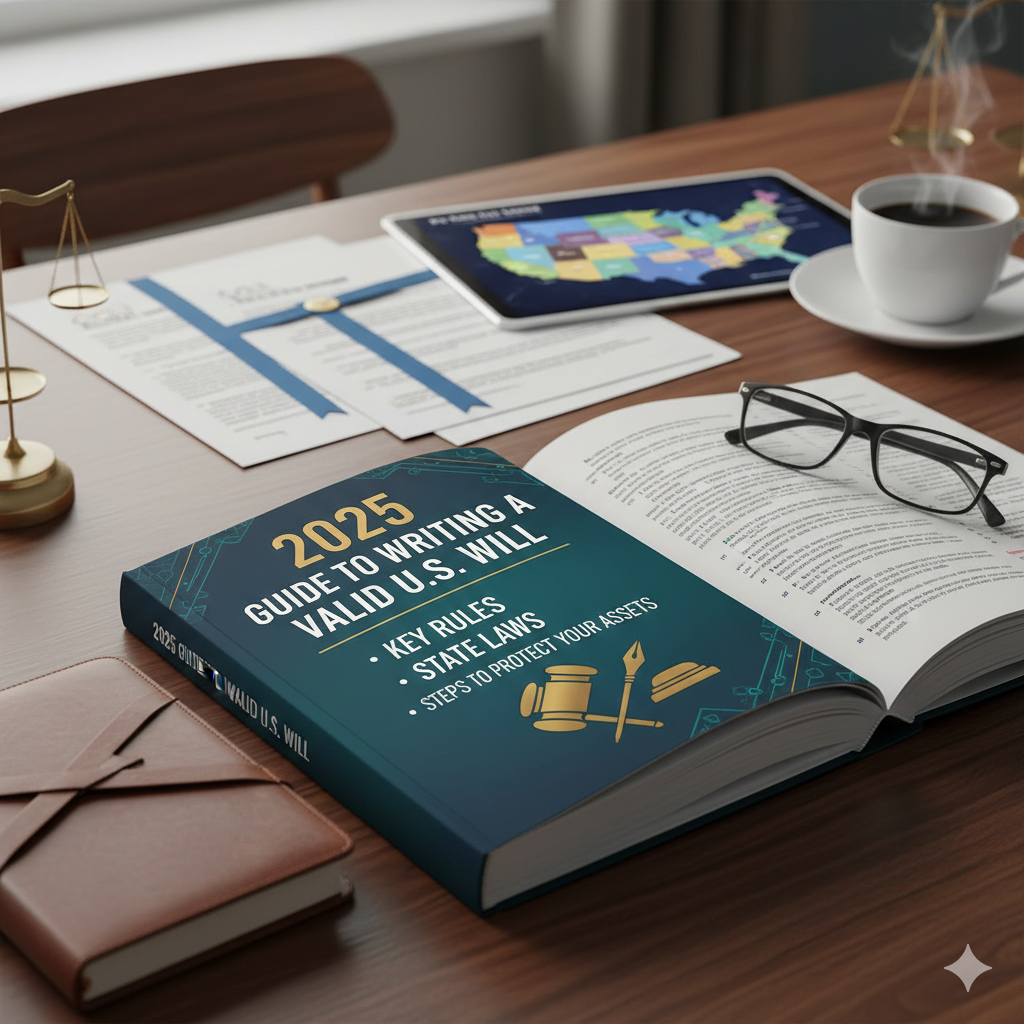
Planning for the future isn’t just about finances, it’s about protecting your loved ones and making sure your wishes are honored. A legally valid will is the foundation of smart estate planning in the United States. It gives you control over who inherits your assets, who manages your estate, and who will care for your minor children.
Because U.S. will laws vary by state, the signing requirements and legal formalities differ from California to New York and beyond. That means even a small mistake like missing witness signatures, can cause delays, disputes, or even invalidate your will.
This 2025 step-by-step guide breaks down how to write a will in plain English, explains the key legal rules that apply across the U.S., highlights landmark court cases, and points you to reliable resources like IRS guidance, state probate codes, and trusted legal databases. By the end, you'll know exactly how to protect your assets, avoid common legal errors, and create a will that stands up in court.
STEP-BY-STEP: DRAFTING AND EXECUTING A U.S. WILL (2025)
1. Map your goals and your “estate picture”
Start by writing down everything you own and understanding how each asset will transfer after your lifetime.
- Probate assets - These go through your will and the probate court process. (Example: property or bank accounts in your name only)
- Non-probate assets - These do not go through your will because they have built-in beneficiaries or ownership rules. This includes:
- Transfer-on-death (TOD) deeds
- Jointly owned property with right of survivorship
- Life insurance policies
- Retirement accounts like 401(k)s and IRAs (Individual Retirement Account) with named beneficiaries
Make sure your will matches the beneficiaries listed on your financial accounts. If they don’t match, the beneficiary forms usually win even if your will says something else.
2. Choose your fiduciaries
Next, decide who will take care of your wishes:
- Executor (also called Personal Representative): This is the person who will manage your estate, file your will in court, pay any debts, and make sure assets are distributed as you planned.
- Guardian for minor children: If you have young children, name someone you trust to care for them if you're not around.
It’s wise to name backup options (successors) for each role, so there’s someone ready to step in if your first choice is unable or unwilling to serve.
3. Decide the dispositive plan
- Specific gifts, residuary clause, alternates, and a simple “no-contest” clause where allowed.
- Add a disposition of digital assets and authority language; most states have adopted the Revised Uniform Fiduciary Access to Digital Assets Act (RUFADAA).
4. Choose the Right Type of Will: Paper, Handwritten, or Electronic
Before you start writing, decide what type of will you want to create. Different states recognize different formats, and each comes with its own rules.
i. Traditional (Witnessed) Will
This is the most common and most reliable format.
It must be written, signed by you, and signed by two witnesses who see you sign (or hear you acknowledge your signature).
Many states follow the Uniform Probate Code (UPC S. 2-502) for these requirements.
Examples:
· California: Probate Code S. 6110 — must be in writing, signed by the testator, and witnessed by two witnesses at the same time.
· New York: EPTL S. 3-2.1 — must be written, signed at the end, and witnessed by two attesting witnesses.
· Florida: S. 732.502 — written, signed at the end, and witnessed by two witnesses, with strict compliance required.
This is the safest format and is recognized in all states.
ii. Holographic (Handwritten) Will
Some states allow handwritten wills, but not all do.
They usually must be entirely in your handwriting and clearly show your intent to create a will.
Rules vary a lot by state, so always check your state law first.
iii. Electronic Will (E-Will)
More states are starting to allow fully digital wills. These often require:
· Verified identity
· Electronic signatures
· Witnesses present (in-person or by approved video method)
· Secure electronic storage with a qualified custodian
Examples:
· Florida: Electronic Wills Act (Part V, S. 732.521–732.525)
Because e-will laws are still developing, you should confirm if your state allows them before relying on this format.
5. Execute the will with required formalities
· Sign in the presence of the required number of witnesses (typically two disinterested adults).
· Many states permit a self-proving affidavit (notarized statements by you and the witnesses) to streamline probate.
· Notarization usually is not a substitute for witnesses unless your state’s statute says otherwise; it’s mainly for self-proving.
6. Add protective clauses & coordinate beneficiary designations
- Simultaneous death/survivorship period and alternate beneficiaries.
- Slayer rule reference (your will can acknowledge disinheritance of anyone who intentionally kills you; states also codify this). UPC § 2-803.
- Confirm beneficiary forms on retirement/insurance match your will; ERISA plan designations control payouts.
7. Store, share, and keep current
- Keep the original will in a safe but accessible place; tell your executor where it is.
- Review on major life events (marriage, divorce, births, moves, major purchases).
- Revocation/updates: Most states track UPC § 2-507 (new will or physical act like tearing/canceling) and state analogs (e.g., California Prob. Code § 6120). Don’t mark up your original; execute a new will or codicil.
8. Know the Tax Basics
Before finalizing your will, keep these tax points in mind:
- Federal estate tax:
- In 2025, you can leave up to $13.99 million without paying federal estate tax.
- Most people won’t reach this amount, but very large estates should plan for it.
- Married couples can also transfer any unused exemption to the surviving spouse by filing IRS Form 706 on time.
- State taxes:
- Some states have their own estate or inheritance tax.
- This is separate from the federal tax, so check your state’s official tax or treasury website to see if it applies to you.
DO YOU NEED A LAWYER TO WRITE A WILL
No, in most U.S. states, you can legally write your own will without hiring a lawyer, and many people do it successfully, especially when their finances and wishes are straightforward. However, you must follow your state's signing and witness rules exactly for your will to be valid. A simple handwritten will may be allowed in some states, while others require a typed will with two witnesses. Even if you choose to do it yourself, it's smart to use a reliable template, keep your language clear, and update your beneficiary forms to match your will. However, if your situation is more complex for example, you have a blended family, own a business or several properties, or need trusts, it’s a smart idea to talk to an estate-planning attorney. They can help you avoid costly mistakes and future conflicts.
LANDMARK JUDGMENTS
Court decisions play a major role in how wills are interpreted and enforced. Here are a few important cases every estate-planning reader should know:
· In re Estate of Kuralt, 15 P.3d 931 (Mont. 2000)
The Montana Supreme Court accepted a handwritten letter as a valid amendment (codicil) to a will because it clearly showed testamentary intent.
Key takeaway: In states that allow handwritten wills or codicils, clear intent matters. But relying on handwritten notes can invite conflict a properly drafted will is safer.
· Egelhoff v. Egelhoff, 532 U.S. 141 (2001)
The U.S. Supreme Court ruled that beneficiary designations on retirement plans governed by ERISA override state law, even after a divorce.
Key Takeaway: Always keep your beneficiary forms updated your will cannot change who receives employer-sponsored retirement benefits.
· Estate of Duke, 61 Cal. 4th 871 (Cal. 2015)
The California Supreme Court allowed a will to be corrected when there were clear evidence of a drafting mistake and the true intent of the person who made the will.
Key Takeaway: If a will contains a clear drafting error, courts may fix it but only when strong proof of your true intent exists. Clear wording helps avoid disputes.
CONCLUSION
Creating a valid will in the U.S. isn’t complicated. You just need to follow your state’s rules, sign it properly, and make sure it matches your beneficiary forms. Use the right witnesses, add a self-proving affidavit if your state allows it, and store your original will somewhere safe.
Keeping your will updated when life changes i.e. marriage, kids, divorce, new property, helps avoid family disputes and court delays.
If your situation involves blended families, special-needs planning, multiple properties, or a business, speaking with an estate-planning attorney is worth it. A little planning today can save your loved one’s money, and time tomorrow.
For expert guidance on creating a legally valid U.S. will, structuring estate-planning documents, or ensuring your beneficiary designations and asset transfers comply with state and federal rules, connect with our legal experts at YLA. We help individuals and families protect their legacy with clarity, confidence, and compliance
FREQUENTLY ASKED QUESTIONS (FAQS):
1. What happens if I die without a will?
State intestacy laws decide who gets your assets. Usually spouse and children first, then parents, then siblings. The court picks your executor.
2. Can you make a digital or electronic will?
Yes, but only in states with e-will laws (such as Florida and Arizona). Rules may include electronic signatures and online witnesses.
3. How often should I update my will?
Review it every 3–5 years or after major life changes like marriage, divorce, a new child, or a move to another state.
4. Can I include digital assets in my will?
Yes. You can name someone to manage your digital accounts, online files, and social media under laws like the Revised Uniform Fiduciary Access to Digital Assets Act (RUFADAA).
5. Do I need a lawyer to write a will in the U.S.?
No. You can write your own will, but you must follow your state’s legal signing rules. A lawyer is recommended for complex situations like blended families, business ownership, or large estates.
OTHER RELEVANT BLOGS
1. Estate Planning Basics for US
ABOUT THE AUTHOR
Adv. Sanjana Mishra is a corporate lawyer and Legal Consultant specializing in corporate law, legal agreements, contract drafting, and regulatory compliance. She has experience drafting diverse commercial agreements and advising startups. Through YLA, she simplifies legal concepts to help businesses make informed, compliant, and growth-driven decisions.
DISCLAIMER
The information provided in this article is for general educational purposes and does not constitute a legal advice. Readers are encouraged to seek professional counsel before acting on any information herein. YLA and the author disclaim any liability arising from reliance on this content.

Related Articles


Leave a Comment