SECURE YOUR INNOVATION: ESSENTIAL U.S. CONTRACT CLAUSES FOR IP, DATA PRIVACY & CYBERSECURITY
By Yourlegalassistant Team
INTRODUCTION
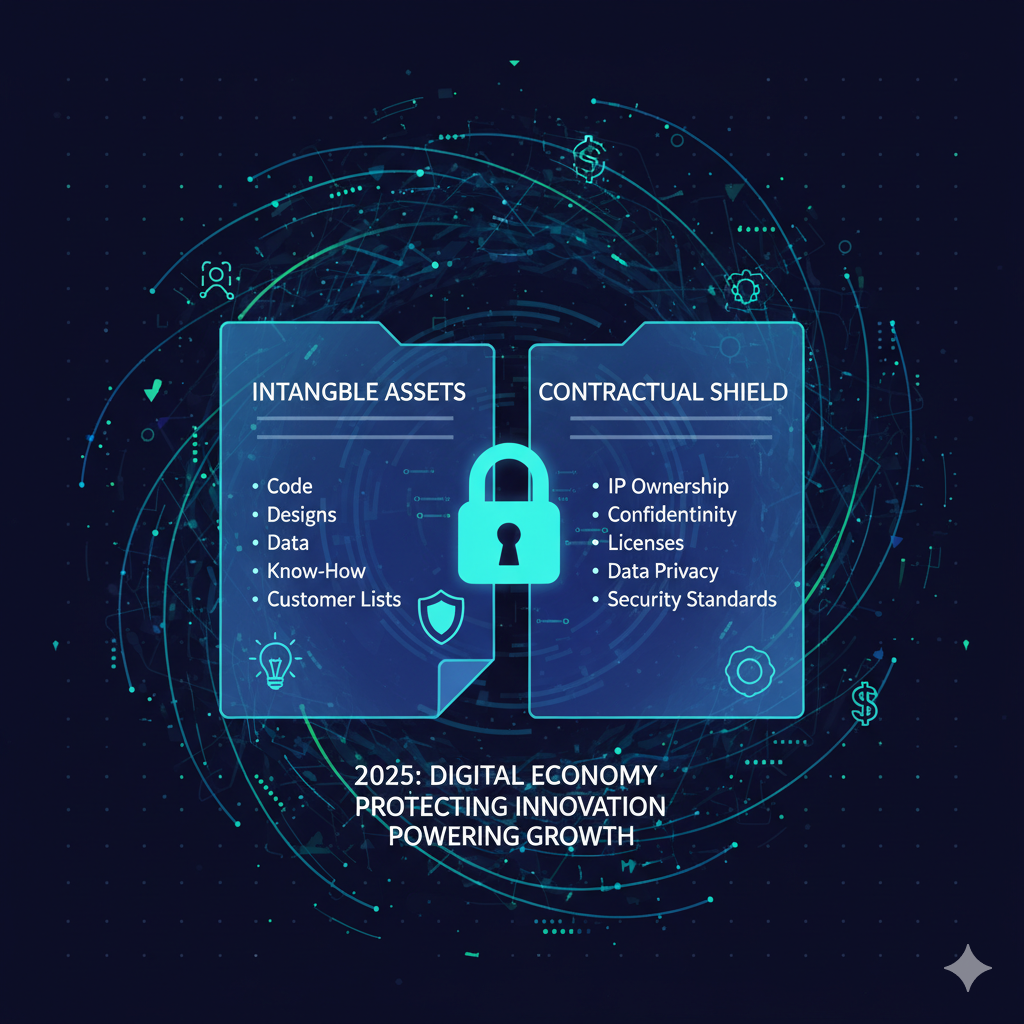
Your company’s most valuable assets are often the ones you can’t touch: code, designs, data, know-how, customer lists and more. The right contract language turns those intangibles into protectable business value (and keeps regulators happy). In today’s digital economy, your data and intellectual property aren’t just valuable - they are the backbone of your business. And in 2025, contracts do far more than outline responsibilities. They determine who truly owns innovations, how sensitive information must be protected, and who carries the risk when a cybersecurity issue strikes.
Whether you’re developing software, building AI models, or managing customer data, the right contract clauses can safeguard your trade secrets, protect your brand, and keep you compliant with U.S. privacy and cybersecurity laws. This guide breaks down the essential clauses you need, the key statutes behind them, and landmark cases shaping how courts and regulators expect businesses to protect their innovations.
CORE IP CLAUSES
1. INTELLECTUAL PROPERTY
IP ownership language sits at the heart of any technology, consulting, creative services, or collaborative research agreement. Strong IP ownership clauses set expectations, prevent disputes, and ensure innovation is protected. Whether you're drafting for a startup founder, a SaaS provider, a creative agency, or a research collaboration, clear drafting helps avoid disputes, protect investment, and ensure both parties know their rights from day one. Broadly, IP ownership frameworks fall into four categories:
a. Sole ownership
Under a sole-ownership structure, one party receives full and exclusive rights to all IP created in connection with the engagement. This model is widely used in work-for-hire and client-service arrangements, where the client funds the work and expects to own the results.
b. Joint ownership
Joint ownership means both parties share rights to the newly created IP. Because joint IP can become complicated especially when licensing, future monetization, and enforcement are involved agreements should clearly spell out how each party may use the IP.
c. Pre-existing IP
Parties often bring proprietary materials, technology, code libraries, or methodologies into a project. These pre-existing assets known as “Background IP” should remain with the original owner unless a written license or assignment says otherwise.
d. Newly developed IP
This provision clarifies who owns any new innovations, content, software, or inventions created during the engagement. Where the service provider creates deliverables for a client, ownership typically passes to the client.
2. TRADE SECRETS & CONFIDENTIALITY
Modern confidentiality clauses and NDAs should not only define what qualifies as confidential information, but also clearly outline how it must be protected and used. Under U.S. law, this means aligning your contracts with the Defend Trade Secrets Act (DTSA) and including the mandatory whistleblower-immunity notice as without it, you risk losing key remedies in court.
If you’re sharing brand assets, logos, trademarks, co-branding, define:
i. How and where marks can be used
ii. Add rules for brand use so partners don’t damage your trademark or use it incorrectly.
3. LICENSE SCOPE
Your contract should clearly outline what rights are being granted, to whom, and for what purpose. Specify whether the license covers source code or object code, and whether it’s limited to internal use or allows resale, distribution, or commercialization.
Spell out exactly what’s being licensed:
a) Source vs. object code
b) Internal use vs. resale/distribution
c) Field-of-use limits
d) Sublicensing & derivative works
e) Open-source compatibility
f) Add termination rights and a post-termination wind-down period.
4. CALIFORNIA PRIVACY COMPLIANCE (CCPA/CPRA)
If vendors access California personal data, your contract must be CCPA/CPRA-compliant. Without these terms, your vendor may be considered a “data seller” under California law exposing your business to serious compliance and enforcement risks. So, make sure that your business-
a) Limit data use to specific purposes
b) Ban secondary use/sale
c) Require help with deletion/consumer requests
5. DATA PRIVACY
Strong privacy terms don’t stop at collection, they govern how data is stored, used, and eventually deleted. Your contract should set clear data-deletion timelines, retention limits, and de-identification standards consistent with HIPAA and state privacy guidance. This includes:
a) Data deletion timelines
b) Retention limits
c) De-identification standards
d) Vendor cooperation on privacy requests and breaches
6. SECURITY STANDARDS
To reinforce trust and security set a clear security benchmark, use recognized framework like NIST SP 800 or require “industry-standard security at minimum.” Make sure security requirements scale based on how sensitive the data is and how important the systems are. Clearly define what counts as a “Security Incident.” Require the vendor to act immediately to contain the issue, cooperate fully, and notify you within a set time frame (for example, within 72 hours—or sooner if the law requires faster notice).
If you're a public company, make sure the contract supports your SEC obligations. Under the SEC cybersecurity rule, you must disclose any material cyber incident on Form 8-K within four business days after deciding it's material, and follow Under the SEC cybersecurity rule, you must disclose any material cyber incident on Form 8-K within four business days after deciding it's material, and follow Reg S-K Item 106 rules on cyber governance and risk management.
Block unauthorized scraping or system access, but draft correctly under the narrowed Computer Fraud and Abuse Act interpretation.
DAMAGE CONTROL: ALLOCATING RISK BEFORE TROUBLE STRIKES
When something goes sideways, your contract decides who carries the burden. Start with targeted indemnity clauses not generic ones. These should specifically cover intellectual property infringement, data breaches caused by negligence, and, where allowed by law, regulatory penalties. Make sure the contract clearly outlines defense obligations and reasonable exceptions, such as problems caused by unauthorized system changes or improper integrations.
Next, include reasonable liability caps, but protect yourself by carving out serious issues like IP violations, confidentiality breaches, willful misconduct, and data-privacy failures. Also spell out the types of losses that can be recovered, think investigation and forensics costs, system restoration expenses, and breach-notification and credit-monitoring services.
Build in strong oversight protections. Reserve the right to conduct security audits, request SOC 2 (System and Organization Controls 2) reports or independent assessments, and require approval for any subcontractors who will handle sensitive data. Security obligations should extend across the entire vendor chain to avoid hidden risks.
Lastly, plan your exit strategy. Include a termination for security cause clause so you can suspend or end the relationship if the other party repeatedly fails to meet security standards. Require secure return or destruction of data and reasonable support during transition to protect your systems and ensure business continuity.
LANDMARK JUDGEMENTS
Public Web Scraping - hiQ Labs v. LinkedIn (9th Cir., 2022):
The court held that scraping publicly available profile data doesn’t typically violate the CFAA (Computer Fraud and Abuse Act), even if the platform has issued a cease and desist notice. In short, public data isn’t automatically protected by hacking laws.
Key takeaway: Rely on strong website terms and real technical barriers (like login requirements and rate limits) to control scraping legal terms and access controls must reinforce each other.
Agreeing to Online Terms — Specht v. Netscape (2d Cir., 2002) & ProCD v. Zeidenberg (7th Cir., 1996)
Courts have made it clear: online terms are only enforceable when users can easily see them and clearly agree. If the terms are buried, hard to find, or acceptance isn’t obvious, you risk losing the ability to enforce them.
Key takeaway: Make your online agreements impossible to miss. Use clear, visible consent steps, like obvious “I agree” buttons and bold notices, so users actually understand what they’re accepting. If someone can’t easily see and agree to your terms, a court may decide they never agreed at all. In short: no hidden terms, no buried links, no sneaky clicks.
CHECKLIST
Use this checklist to ensure your agreement clearly defines IP ownership and creates enforceable protection for your innovations:
a. Define Ownership Upfront
Clarify who owns pre-existing IP, newly developed IP, and jointly created works.
b. Work Made for Hire and Assignment Language
Make clear that any qualifying deliverables are treated as “work-made-for-hire” under. For anything that doesn't fall under that definition, include a present-tense assignment clause to ensure all rights automatically transfer to your company.
c. Scope of License Rights
Specify what rights are being granted (use, reproduce, display, modify, distribute) and any limitations on those rights.
d. Field-of-Use & Territory Limits
Define where and how the licensed assets can be used (e.g., internal use only, U.S. only, no resale).
e. Restrictions on Use
Prohibit unauthorized sublicensing, reverse engineering, derivative works, or commercial exploitation unless expressly allowed.
f. Background vs. Foreground IP
Identify existing technology/IP each party brings (background) and who owns new outputs (foreground).
g. Open-Source Compliance
Require disclosure and compliance for any open-source components included in deliverables.
h. IP Protection & Confidentiality
Tie IP use to confidentiality standards and add remedies for misuse or misappropriation.
i. Post-Termination Rights
Address whether any license continues after termination and requires prompt return or destruction of proprietary materials.
j. Enforcement & Remedies
Preserve rights to injunctive relief, damages, and attorney’s fees for IP violations or unauthorized use.
CONCLUSION
In a market where intellectual property, data, and technology drive business value, strong contracts aren’t just legal documents they’re risk-management tools and competitive assets. Clear IP language determines who owns creations, how they can be used, and what happens when rights are violated. When combined with solid privacy, cybersecurity, and liability provisions, your agreements do more than manage transactions they secure your ideas, protect revenue, and reinforce trust with partners and customers.
In short, thoughtful drafting now prevents disputes later and ensures your innovation stays in your control, not in your opponent’s hands. Strong contracts don’t slow business they power safe, scalable, and defensible growth.
For expert guidance on drafting strong IP agreements, building privacy compliant vendor contracts, or strengthening cybersecurity clauses that meet U.S. legal and regulatory standards, connect with our legal team at YLA.
FREQUENTLY ASKED QUESTIONS (FAQS):
1. What is an IP ownership clause in a contract?
An IP ownership clause explains who legally owns any intellectual property created during a business relationship. It ensures both parties understand rights to content, code, inventions, or proprietary materials developed under the agreement.
2. Who usually owns IP in a service agreement?
In most U.S. service and “work-for-hire” contracts, the client owns the IP created by the service provider. However, ownership must be clearly stated otherwise the creator may keep the rights by default under 17 U.S.C. Sec. 101 & 201.
3. What is the difference between sole ownership and joint ownership?
Sole ownership gives one party exclusive rights to all IP produced.
Joint ownership gives both parties shared rights, requiring clear rules on use, licensing, and revenue sharing.
4. How do you protect newly created IP in a contract?
Clearly state who owns the IP developed during the engagement, and include further-assurance and assignment language to ensure full transfer of rights when intended.
5. Do I need a written agreement to transfer IP rights?
Yes. Under U.S. law, copyright and patent rights must be transferred in writing to be valid. Verbal promises are not enough.
6. Why are IP ownership clauses important for startups and tech companies?
Clear IP terms protect core assets like code, algorithms, and inventions. They also help avoid investor concerns during due diligence, especially in fundraising and M&A transactions.
7. Do IP rights apply to digital content and software?
Yes. U.S. IP laws protect creative works, software, code, designs, trade secrets, and more. Digital assets need explicit ownership terms to avoid disputes.
ABOUT THE AUTHOR
Adv. Sanjana Mishra is a corporate lawyer and legal content strategist specializing in corporate law, contract drafting, and regulatory compliance. She has experience drafting diverse commercial agreements and advising startups. Through YLA, she simplifies legal concepts to help businesses make informed, compliant, and growth-driven decisions.
DISCLAIMER
The information provided in this article is for general educational purposes and does not constitute a legal advice. Readers are encouraged to seek professional counsel before acting on any information herein. YLA and the author disclaim any liability arising from reliance on this content.

Related Articles

Leave a Comment